How global warming and feedbacks are causing huge albedo changes in the Arctic.Snow cover declineDecline of the snow cover on land in the northern hemisphere is accelerating, as illustrated by the image below and the image underneath on the right. (1)
Fresh snow can have an albedo as high as 0.85, meaning that up to 85% of the sunlight falling on snow can get reflected back into space. As the snow melts, its structure changes making it less reflective, i.e. its albedo will go down, to as low as 40%. (2)
As a result, more sunlight gets absorbed, accelerating the melting process. Eventually, where snow melts away, spots of bare soil become exposed, and dark wet soil has a very low albedo, reflecting only between 5% and 15% of the sunlight. Thus, even more sunlight gets absorbed and the soil's temperature increases, causing more of the remaining snow to melt. (2)
Changes in vegetation can further accelerate this process. Russia's boreal forest - the largest continuous expanse of forest in the world - has seen a transformation in recent years from larch to conifer trees. Larch trees drop their needles in the fall, allowing the vast, snow-covered ground in winter to reflect sunlight and heat back into space and helping to keep temperatures in the region very cold. But conifers such as spruce and fir retain their needles, which absorb sunlight and increase the forest's ground-level heat retention. (3)
A conversion from larch to evergreen stands in low-diversity regions of southern Siberia would generate a local positive radiative forcing of 5.1±2.6 W m−2. This radiative heating would reinforce the warming projected to occur in the area under climate change. (4)
Tundra in the Arctic used to be covered by a white blanket of snow most of the year. However, as the landscape is warming up, more trees and shrubs appear. Scientists who studied part of the Eurasian Arctic, found that willow and alder shrubs, once stunted by harsh weather, have been growing upward to the height of trees in recent decades. They now rise above the snowfall, presenting a dark, light-absorbing surface. This increased absorption of the Sun's radiation, combined with microclimates created by forested areas, adds to global warming, making an already-warming climate warm even more rapidly. (5 & 6)
Furthermore, encroachment of trees onto Arctic tundra caused by the warming may cause large release of carbon to the atmosphere, concludes a recent study. This is because tundra soil contains a lot of stored organic matter, due to slow decomposition, but the trees stimulate the decomposition of this material.
(7)
 Sea ice decline
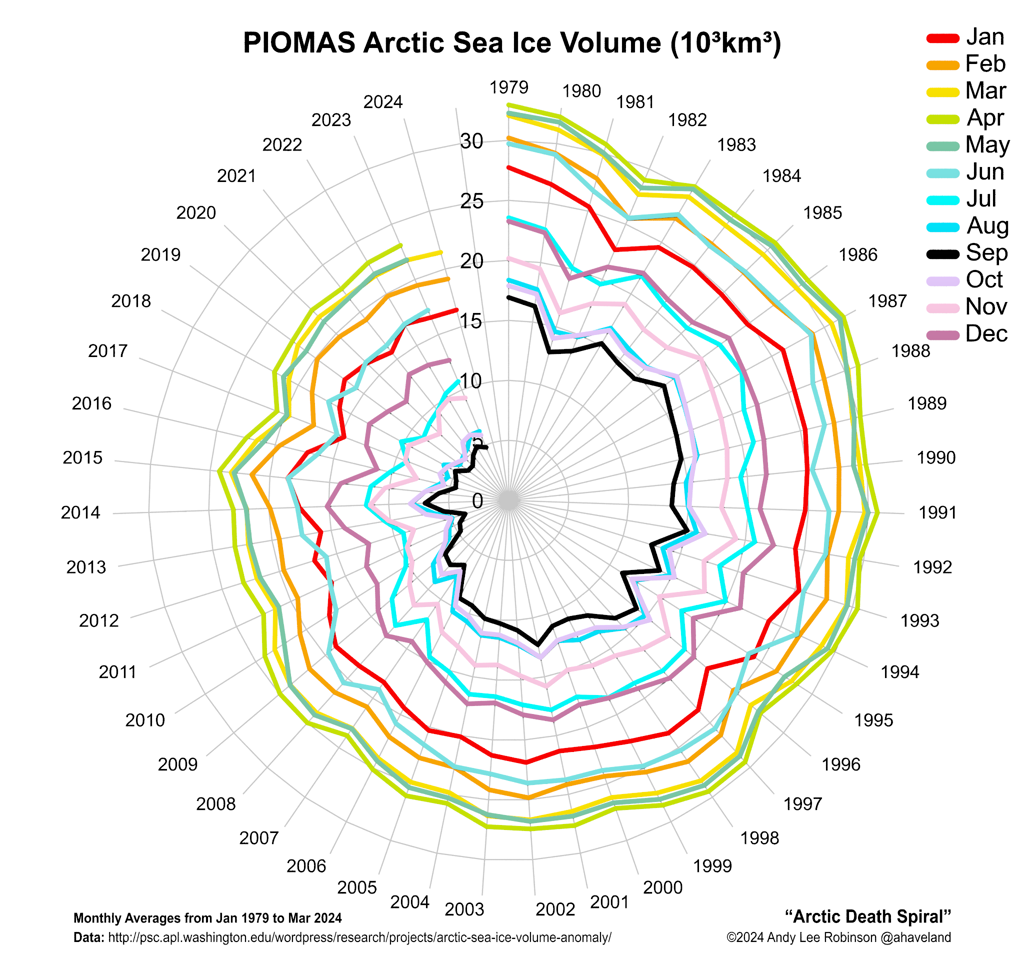
In the Arctic, sea ice volume has fallen dramatically over the years, as illustrated by the image on the right. The trend points at 2014 as the year when Arctic sea ice will first reach zero volume for some time during that year. (8)
The Arctic Ocean looks set to be ice-free for a period of at least three months in 2015 (August, September and October), and for a period of at least 6 months from the year 2020 (June through to November). (9)
Decline of the Arctic sea ice is accelerating, due to numerous feedbacks. As the Arctic atmosphere warms up, any snow cover on top of the ice will melt away ever quickly, decreasing the surface albedo and thus reinforcing the warm-up. As melt ponds appear on top of the ice, the albedo will drop even further.
Sam Carana's Diagram of Doom pictures ten feedbacks that jointly work to accelerate sea ice decline. (10)
The image below shows the three areas where albedo change will be felt most in the Arctic, i.e. sea ice loss, decline of albedo in Greenland and more early and extensive retreat of snow and ice cover in other areas in the Arctic. (8)
References1. Northern Hemisphere Snow Cover Anomalies 1967-2012 June, Rutgers University
climate.rutgers.edu/snowcover/chart_anom.php?ui_set=1&ui_region=nhland&ui_month=62. Albedo, Albedo Change blog
albedochange.blogspot.com/2009/02/albedo-change.html3. Shift in Northern Forests Could Increase Global Warming, Scientific American, March 28, 2011
scientificamerican.com/article.cfm?id=shift-northern-forests-increase-global-warming4. Sensitivity of Siberian larch forests to climate change, Shuman et al., April 5, 2011, Wiley.com
onlinelibrary.wiley.com/doi/10.1111/j.1365-2486.2011.02417.x/abstract5. Warming turns tundra to forest
ox.ac.uk/media/news_stories/2012/120604.html6. Eurasian Arctic greening reveals teleconnections and the potential for structurally novel ecosystems, Macias-Fauria et al., 2012
nature.com/nclimate/journal/v2/n8/full/nclimate1558.html7. Expansion of forests in the European Arctic could result in the release of carbon dioxide, University of Exeter news, June 18, 2012
exeter.ac.uk/news/featurednews/title_214902_en.html8. Big changes in the Arctic within years, Sam Carana, October 26, 2012, Arctic-News blog
arctic-news.blogspot.com/2012/10/big-changes-in-arctic-within-years.html9. Getting the Picture, Sam Carana, August 2012, Arctic-News blog
arctic-news.blogspot.com/2012/08/getting-the-picture.html10. Diagram of Doom, Sam Carana, August 2012, Arctic-News blog
arctic-news.blogspot.com/2012/08/diagram-of-doom.htmlFurther reading- Albedo change in the Arctic
arctic-news.blogspot.com/2012/07/albedo-change-in-arctic.html- Greenland is melting at incredible rate
arctic-news.blogspot.com/2012/07/greenland-is-melting-at-incredible-rate.html- Albedo change in the Arctic threatens to cause runaway global warming
arctic-news.blogspot.com/2012/10/albedo-change-in-the-arctic-threatens-to-cause-runaway-global-warming.html