Showing posts with label Syria. Show all posts

Wednesday, January 22, 2014

Photo Archive Is Said to Show Widespread Torture in Syria

BEIRUT, Lebanon — Emaciated corpses lie in the sand, their ribs protruding over sunken bellies, their thighs as thin as wrists. Several show signs of strangulation. The images conjure memories of some of history’s worst atrocities.

Numbers inscribed on more than 11,000 bodies in 55,000 photographs said to emerge from the secret jails of Syria’s president, Bashar al-Assad, suggest that torture, starvation and execution are widespread and even systematic, each case logged with bureaucratic detail.

This collection of images was identified as having been part of a voluminous archive of torture and execution maintained by the Syrian government and smuggled out by a police photographer who defected and was given the code name Caesar.

So far, only a few photographs have actually been released by lawyers commissioned by the Qatari government, an avowed opponent of Mr. Assad, and the claims about their origins could not be independently verified.

If genuine, the trove is new visual corroboration that Mr. Assad’s government is guilty of mass war crimes against its own citizens, just as it appeared to regain some international standing.

Click here to read the full article (Warning: Graphic Content)

Source: The New York Times, January 21, 2014

Saturday, July 27, 2013

Top Executioners For 2012: China, Iran and Iraq

Execution in China
July 26, 2013: Of the 40 countries worldwide that retain the death penalty, 33 are dictatorial, authoritarian or illiberal States.

Seventeen of these countries were responsible for approximately 3,909 executions, 98.5% of the world total in 2012.

China alone carried out about 3,000, about 76%, of the world total of executions; Iran put at least 580 people to death and Iraq, at least 129; Saudi Arabia, at least 84; Yemen, at least 28; North Korea, at least 20; Sudan, at least 19; Afghanistan, 14; Gambia, 9; Somalia, at least 8; Palestine (Gaza Strip), 6; South Sudan, at least 5; Belarus, at least 3; Syria, at least 1; Bangladesh, 1; Pakistan, 1; and United Arab Emirates, 1.

Many of these countries do not issue official statistics on the practice of the death penalty, therefore the number of executions may, in fact, be much higher.

This is the prevalent situation worldwide concerning the practice of the death penalty. It points to the fact that the fight against the death penalty entails, beyond the stopping of executions, a battle for transparency of information concerning capital punishment, for democracy, for respect of the rule of law and for political rights and civil liberties.

The terrible podium of the world’s top executioners is occupied by three authoritarian States in 2012: China, Iran and Iraq.

Although the death penalty remains a State secret in China, some news in recent years, including declarations from official sources, suggest that the use of the death penalty may have diminished compared to preceding years.

A major turnabout came after the introduction of a legal reform on 1 January 2007, which required that every capital sentence handed down in China by an inferior court be reviewed by the Supreme People’s Court (SPC). Since then, the top court has overturned “on average” 10 per cent of death sentences handed down each year in the country.

According to William A. Schabas, Professor of international law at Middlesex University in London, in 2012 “China has probably executed about 3,000 people.” “This represents a decline of more than 50% from the number only five years ago,” he wrote on his blog on 18 December 2012, after more than a decade of his participation in various conferences on capital punishment in China and many encounters with experts in the Chinese criminal justice system.

According to the Dui Hua Foundation’s estimate, “the number of executions has been sharply reduced, although in 2012 it remained high at around 3,000 per year.” The Dui Hua Foundation, a San Francisco-based group that works on behalf of political prisoners and monitors Chinese prisons, estimated that China had carried out “about” 4,000 executions in 2011, while there were “about” 5,000 in 2010, as in 2009, still a slight decrease as compared to 2008, when the number of executions “exceeded 5,000 and may have been as high as 7,000.” According to the Foundation, run by business executive-turned-human-rights advocate John Kamm – who still maintains good relations with government officials – about 6,000 people were executed in 2007, a 25 to 30 per cent drop from 2006, in which estimates reported at least 7,500 executions.

Given that the great majority – at least 90 per cent – of these cases are death penalty review cases, as the SPC doesn’t have jurisdiction over many other cases, an approximate but realistic estimate would put the number of death sentences in 2012 – between definitive sentences and those suspended for two years – at around 8,300, a sharp decrease from about 9,400 estimated in 2011.

Considering further that, since February 2010, the Supreme People’s Court has recommended to use a policy of “justice tempered with mercy,” suggesting to the courts to “suspend the death sentence for two years for all cases that don’t require immediate execution,” it is realistic to conclude that the executions in 2012, as estimated by Professor William Schabas and the Dui Hua Foundation, were about 3,000, a significant decrease compared to the 4,000 of 2011.

On 14 March 2012, China amended again the 1979 Criminal Procedure Law, highlighting the human rights protection. A phrase calling for “respecting and protecting human rights” was added to the revised law’s first chapter on aim and basic principles. The amendment further specifies the procedures for the Supreme People’s Court to review death penalty cases in order that such cases will be handled “with sufficient care”, and “legal oversight” will be strengthened.

According to the fifth annual report of Iran Human Rights (IHR) on the death penalty in Iran, in 2012 the Islamic Republic carried out at least 580 executions, a number among the highest in more than 15 years. According to Human Rights Activists in Iran, at least 587 people were executed in 2012.

Iran Human Rights emphasizes that the actual number of executions is probably much higher than the figures included in its annual report. At least 240 additional executions were not included in the report, due to difficulties in confirming some of the details. In fact, only 85 out of the 325 estimated secret executions in Vakilabad Prison were included in the 2012 report. In 2011, on the basis of these same sources, Iran Human Rights had estimated at least 676 executions.

Since the 2009 post-election protests in Iran, the number of executions, particularly public executions, has risen dramatically. According to Iran Human Rights, in 2012 there were at least 60 public executions, a number six times higher than numbers from 2009, when at least 12 people were hanged in public places. In 2010, at least 19 people were hanged publicly. In 2011, public executions have more than tripled, with at least 65 people being executed in public. The trend has continued in 2013. Just in January and February 2013 alone, at least 20 people were hanged in public. As of 30 June, at least 37 public executions were held.

The execution of child offenders continued into 2012 and 2013, in open violation of the Convention on the Rights of the Child to which it is a co-signatory. A juvenile offender was executed in public in March 2012, according to Amnesty International. Another two possible minor offenders were executed 2013 (in January and February).

The use of the death penalty for purely political motives continued in 2012 and 2013. But it is probable that many of the people put to death for ordinary crimes or for “terrorism,” may well be in fact political opponents, in particular members of Iran’s ethnic minorities, including Iranian Azerbaijanis, Kurds, Baluchis, and Arabs. Accused of being Mohareb – enemies of Allah – those arrested are often subject to rapid and severe trials that often end with a sentence of death. The punishment for Moharebeh is death or amputation of the right hand and left foot, according to the Iranian penal code. According to Iran Human Rights, at least 23 (3%) of 294 people who were executed in 2012 according to the official Iranian sources were convicted of Moharebeh (war against God).

However, the death penalty is not the only punishment dictated by the Iranian implementation of Sharia. There is also torture, amputation, flogging and other cruel, inhuman and degrading punishments. These are not isolated incidents and they occur in flagrant violation of the International Covenant on Civil and Political Rights that Iran signed and which expressly prohibits such practices.

In 2012, Iraq executed at least 129 people, the highest number since 2005. They were a significant and worrying increase compared to the previous year when at least 68 people were executed.

Iraq has already executed at least 50 people in 2013 (as of 16 April).

Executions began in August 2005. Since then, as of 16 April 2013, at least 497 executions were carried out, most of them related to acts of terrorism.

In April 2013, there were about 1,400 people held on death row, according to Iraqi Justice Minister Hassan al-Shammari.

Source: Hands Off Cain, 2013 Report, July 26, 2013

Sunday, June 9, 2013

Syria Islamists execute youth in front of family

Beirut: Islamist rebels fighting the Syrian regime shot dead a 15-year-old child in front of his parents and siblings Sunday after accusing him of blasphemy, a monitoring group said.

“An unidentified Islamist rebel group shot dead a 15-year-old child who worked as a coffee seller in (the northern city of Aleppo), after they accused him of blasphemy,” said Syrian Observatory for Human Rights director Rami Abdel Rahman.

Abdul Rahman said the rebel group likely comprised foreign jihadists. “They spoke classical Arabic, not Syrian dialect,” he told AFP.

“They shot the boy twice - once in the mouth, another in his neck - in front of his mother, his father and his siblings,” he added.

The Observatory condemned the execution as “criminal and a gift to the regime of Syrian President Bashar Al Assad.

“This kind of criminality is exactly what makes people in Syria fear the fall of the regime,” Abdul Rahman said.

The Britain-based monitoring group, which relies on a broad network of activists, doctors and lawyers in Syria for its reports, demanded the killers’ arrest.

“We are working on identifying their names,” said Abdul Rahman.

Large swathes of Aleppo city have since last year fallen into rebel hands.

Activists have frequently lashed out against rebel groups which have taken advantage of the security vacuum in Aleppo to commit rights abuses.

Source: Agence France-Presse, June 9, 2013

Monday, May 20, 2013

Saudi Arabia: Syrian national beheaded for drug trafficking

Public beheading in KSA
His beheading brings to 41 the number of people executed in Saudi Arabia since the start of 2013.

Riyadh: Saudi authorities beheaded a Syrian man on Monday after convicting him of drug trafficking, the interior ministry said.

Mohammad Yousuf Ezzeddine was executed in the northern city of Qurayat, near the borders with Jordan, the ministry said in a statement carried by SPA state news agency.

His beheading brings to 41 the number of people executed in Saudi Arabia since the start of 2013, according to an AFP tally.

In 2012, the kingdom executed 76 people, according to a count based on official figures.

Rape, murder, apostasy, armed robbery, homosexuality and drug trafficking are all punishable by death under Saudi Arabia’s version of Sharia, or Islamic law.

Source: Agence France-Presse, May 20, 2013

Friday, March 15, 2013

UAE: Briton and Syrian on death row escape execution as sentence commuted

March 13, 2013: Two men sentenced to death for drug dealing had their sentence commuted to four years in prison by the Appeals Court in the United Arab Emirates.

The court erupted in cheers from the relatives of MB, 19, from Syria, and NL, 21, a Briton, as the verdict was announced. The mother of the Syrian fainted briefly, before coming to and hugging the mother of the Briton.

The Syrian's defence lawyer hugged the mother, saying "I told you we will look back at these days and laugh."

Meanwhile, his sister, told their mother: "See, I wore red today to celebrate."

The Briton's mother was similarly overjoyed, hugging the assembled crowd.

While the Appeals Court cleared the two men of drug dealing, it found them guilty of consumption, and sentenced them to four years in prison to be followed by deportation.

The verdict was welcomed by the Briton's lawyer. "This verdict was expected," he said. "This proves the justice system in the UAE is fair and just."

He added that the defence were considering appealing the four-year jail term too, but were waiting to see the draft verdict.

Source: thenational.ae, March 13, 2013

Tuesday, October 23, 2012

President al-Assad Grants General Amnesty for Crimes Committed before October 23, 2012

President Bashar al-Assad on Tuesday issued the legislative decree No. 71 for 2012 stipulating for granting a general amnesty for the crimes committed before October 23, 2012.

The decree replaces death penalty with life sentence of hard labor or long imprisonment sentence according to the crime.

It also replaces life sentence of hard labor with 20 years imprisonment with hard labor, and it replaces the long-life imprisonment sentence with 20 years imprisonment.

Crimes of smuggling weapons and drug trafficking are excluded from the provision of this decree.

Source: Syrian TV & Radio, October 23, 2012

Related articles:
Jul 03, 2012
Syrian President Bashar al-Assad Monday ratified three laws that impose heavy penalties to those who commit "terrorist" acts in order to change the nature of the regime, reported the official SANA news agency. "Those who ...
Dec 20, 2011
DAMASCUS — Syrian President Bashar al-Assad has signed into effect a law imposing the death penalty on anyone arming "terrorists", state media said on Tuesday amid mounting clashes with rebel troops. "The law ...

Thursday, October 4, 2012

Syrian national executed in Saudi Arabia

October 2, 2012: Saudi Arabia beheaded a Syrian for drug smuggling, the interior ministry announced in a statement carried by the official SPA news agency.

Abdulrahman al-Sweidan was "arrested as he was attempting to smuggle large quantities of narcotic pills into the kingdom," SPA reported.

He was beheaded by sword in the northern region of Jawf.

That brings to 61 the number of people executed in Saudi Arabia so far this year, according to an AFP tally based on official reports.

Source: AFP, October 2, 2012

Thursday, August 23, 2012

Don't Mistake Iran's Brutality For Strength

Tehran's Evin Prison
It cannot be denied that hatred and violence are fundamental characteristics of political power in contemporary Iran. The highest per-capita rate of executions in the world, public hangings, systematic torture and rape in prisons, brutal repression of peaceful protests in the streets, show trials and hate propaganda, criminalization of political and religious dissent, the smearing of all opposition as a "foreign conspiracy," these notorious human rights abuses are all too familiar.

A central challenge in the Iranian people's historical struggle to achieve freedom and build a better future is how to reconcile with past violence in order to achieve a non-violent democratic transformation and avoid the horrors that we witness daily in places such as Syria. On the one hand, those that have suffered death and injury of family members and others seeking justice cannot be asked to simply forget the past and leave these crimes without an answer.

On the other hand, vengeance will result in further injustice and discourage peaceful change because those in power will fear that they themselves will be exposed to violence. Thus, beyond either forgetfulness or vengeance, the Iranian people must build a vision of truth and justice that will break the silence, recognize and account for past crimes -- not to provoke another cycle of violence, but to help the process of national healing and creating the context for building a non-violent and humane future.

The testimony of victims at the Iran People's Tribunal held in London in June of this year provided a glimpse of the terrible damage that more than three decades of violence has inflicted on the collective psyche of Iranians. A former political prisoner described how she was savagely beaten while 6-months pregnant, while another described a mother being tortured in front of her one-year-old infant. Yet another spoke about a 14-year-old boy crying for his mother as the noose was put around his neck, and another explained how she was forced to pay for the bullets used to execute her 15-year-old in order to retrieve his body.

Others testified that a boy was brutally gang-raped for days until he hanged himself in his prison cell. It is estimated that in the first decade of the revolution between 1979 and 1989, at least 15,000-20,000 people were executed and countless more subject to other forms of abuse in Iran's torture chambers. In the summer of 1987 alone, up to 4,000-5,000 political prisoners were executed within a few days based on Khomeini's fatwa to punish political prisoners with "revolutionary rage and rancour". Beyond doubt, this is the bloodiest period in Iran's contemporary history, and the consequences of this far-reaching political violence still characterize the nature of power in the Islamic Republic today. In this regard, there is a direct connection between impunity for past crimes and the 2009 post-election atrocities in Kahrizak and other places.

In speaking of tens of thousands of victims, we must consider that behind each person there is a name, a family, a universe of human relations and emotions. For every person that was hanged or tortured or raped or unjustly imprisoned, there is a mother and father, a brother or sister, a husband or wife, a son or daughter, a school-friend or childhood playmate, a colleague from work, and so on. For each victim, there is an irredeemable loss, an unbearable anguish, a life-long trauma, affecting wider and wider circles of Iranian society. This unremedied violence continues to have a profound effect on our self-definition as a nation, on how we conceive citizenship and belonging, and the future that we are capable of imagining and building.

The lesson of history is that those who forget the past are bound to repeat the same mistakes again. The change that we need in Iran is not a narrow "regime change" which all too often substitutes one set of tyrants with another set of tyrants. The most profound revolution is that which comes from below, that which transforms the hearts and minds of people. Even if the struggle for freedom and justice eventually pours out into the streets, even if it should result in free and fair elections and respect for human rights and the rule of law, it begins in the conversations around dinner tables, and university campuses, and mosques, and volunteer organizations, and women's and student's groups, and labour unions, and all the other elements that bond people in their everyday lives.

A lasting change that humanizes society and creates national solidarity must be broader than an exclusive focus on power relations. If we cannot reckon with the past, if we cannot substitute justice for vengeance, if we cannot speak truth to power, if we cannot transform the fundamental values that motivate our conduct, the future that we build will be limited and precarious. To move from violence to non-violence, from inhumanity to humanity, we must re-define the basic social relations that are ultimately reflected in the political sphere. Our historical transformation as a great civilization and nation begins in the everyday byways of family, work and social life.

Mahmoud Asgari, 16,  and Ayaz Marhoni, 18, being
prepared for  execution by hanging. The two teenagers
were publicly hanged in Mashhad on July 19, 2005 for
allegedly raping a younger boy. 
Violence is often mistaken as a sign of strength. The exact contrary is true: Violence is the ultimate sign of weakness. The man who tortures a pregnant woman or ties the noose around the neck of a 14-year-old boy or who rapes in prison, and the regime that supports such a system of wickedness and terror, is not only morally depraved, it is also profoundly weak. It is no different than the man who beats his wife and children; he is no man at all; he is a coward who cannot accept his own cowardice, and thus preys on those weaker than him.

The reason why authoritarian regimes, from Argentina's repression of leftists under the military junta, to South Africa's dehumanization of black Africans under apartheid, to Milosevic's ethnic cleansing of Muslims in former Yugoslavia, to the Islamic Republic of Iran's pseudo-religious repression of its citizens today, the reason why such regimes murder and torture and imprison and silence dissent and control free speech, is because they lack legitimacy, because they are afraid of their own people, because they consider power not as a responsibility that makes them answerable to the nation, but as a license for abuse and corruption.

Why else, for example, would the regime be so afraid of the truth, that 25 years after the 1987 mass-executions that it still denies, it would use a bulldozer to remove the evidence of victims' skeletons from Khavaran? How ironic that the seemingly powerful are afraid of even the earthly remains of their victims. The power of truth and justice is far greater than the power of deceit and violence, and history demonstrates that time and again, a people united in their belief in justice and freedom will ultimately prevail.

It must be remembered that justice is not vengeance; it restores the humanity of both the victim and the perpetrator, for to be violent and cruel is a denial of the humanity of both actors. A future Iran must make those in power answerable for their crimes in order to avoid future abuses. There must be a Truth and Reconciliation Commission as in South Africa, because otherwise the unanswered grievances will explode into vengeance and violence. There must be trials of at least some of those most responsible, as in the prosecution of Milosevic and others for the mass-executions of Muslims in Srebrenica.

Ideally, such trials should be before the independent and impartial courts of a future democratic Iran and not the International Criminal Court at The Hague, so we can claim ownership over our own past and build our capacity for justice. Beyond that, a future democratically elected president, perhaps a woman and former political prisoner and torture victim (like President Dilma Russeff of Brazil, who suffered under the military regime in the 1980s before assuming the highest office in her country), perhaps such a future Head of State will apologize to the Iranian people for the crimes of the past and usher in an era of reconciliation. Perhaps she will go to Khavaran and lay flowers on the graves of the nameless victims and help the nation heal. Perhaps she will finally shut Evin prison and make it into a museum like Auschwitz in Poland or Tuol Sleng in Cambodia where the Khmer Rouge tortured thousands.

The way in which we reckon with past violence will determine what kind of future we build for our long-suffering nation. The process of healing and national reconciliation begins with exposing the historical truth about past injustices as the basis for a dialogue among all Iranians as to what it means to be a citizen of this great nation; what it means to be a human being worthy of respect and dignity. Only then will Iran rise to the glory and greatness that it rightfully deserves as a leader among nations.

So long as we inflict mass-violence against our own citizens, so long as we allow political ideologies and beliefs to justify violations of human rights, we can never claim our place in history. Justice embraces both victims and perpetrators: those of us fighting for a better tomorrow must look beyond vengeance and blind rage to aliberating righteousness that will invite even the Basiji forces that beat our brothers and sisters to the table of contrition and brotherhood so that their humanity too can be restored.

Source: Iran Human Rights Documentation Center----Ramin Jahanbegloo is a prominent Iranian philosopher, former political prisoner and professor of political science at the University of Toronto; Payam Akhavan is a former UN prosecutor, founder of the Iran Human Rights Documentation Centre, and professor of international law at McGill University, August 2012

Tuesday, July 3, 2012

Bashar al-Assad approves new anti-terror laws

Syrian President Bashar al-Assad Monday ratified three laws that impose heavy penalties to those who commit "terrorist" acts in order to change the nature of the regime, reported the official SANA news agency. "Those who are direct members of a terrorist group may be sentenced to 10 to 20 years in prison with hard labor, but the punishment will be harder if the goal is to change the regime or the nature of the state," according to the text of the law approved by Parliament last Thursday.

"If these acts result in death or disability for victims, death sentences can be imposed," it added.

Moreover, "the financing of terrorism, that is to say, any action to collect, directly or indirectly, providing money, weapons, ammunition, explosives, communication means and information which can be used in terrorist acts are punishable with 15 to 20 years in prison. "

The lowest penalty - five years in prison – is for those involved in acts that do not result in property damage.

Another law states that an employee may be dismissed if he or she found guilty by a court for " direct or indirect involvement in a terrorist act, or if he/she provides a material or moral support to a terrorist group".

The third law stipulates "10 or 20 years in prison with hard labor" and "fines for the perpetrators of kidnappings for ransom."


Source: albawaba news, July 2, 2012

Related article:
Dec 20, 2011
Syria imposes death penalty for arming 'terrorists'. DAMASCUS — Syrian President Bashar al-Assad has signed into effect a law imposing the death penalty on anyone arming "terrorists", state media said on Tuesday amid ...

Tuesday, June 26, 2012

Saudi Arabia: Five Executed for Murder and Drugs

June 26, 2012: Saudi authorities beheaded four of its citizens for murder and a Syrian national for drug smuggling, the interior ministry said.

Three Saudi nationals were executed in the kingdom's eastern Qatif region for stabbing and then shooting to death an Indian, Kohimo Ahmad, after robbing the shop where he worked, the ministry said in a statement carried by state news agency SPA.

Hussein bin Ahmad Shweikhat, Abdel Aziz bin Hasan al-Maatouq and Hussein bin Ibrahim al-Maatouq were beheaded after the three were found guilty of having stabbed and then shot Ahmad with an automatic rifle.

In a separate case, Khaled bin Saeed al-Asmari, was executed in the town of Abhaa in the kingdom's southern region of Asir for stabbing to death fellow Saudi, Abdullah bin Saad al-Masmaa, after a dispute, the ministry said.

And William Hatoum, a Syrian, was executed in the northern region of Jawf after being found guilty of smuggling drugs into the ultra-conservative kingdom, it said.

Hatoum was the third Syrian national to be executed in Saudi Arabia for drug smuggling since January.

The latest beheadings bring to 45 the number of people executed in Saudi Arabia so far this year, according to an AFP tally based on official reports.

Source: Agence France-Presse, June 26, 2012

Tuesday, December 20, 2011

Syria imposes death penalty for arming 'terrorists'

DAMASCUS — Syrian President Bashar al-Assad has signed into effect a law imposing the death penalty on anyone arming "terrorists", state media said on Tuesday amid mounting clashes with rebel troops.

"The law provides for the death penalty for anyone providing weapons or helping to provide weapons intended for the carrying out of terrorist acts," the official SANA news agency said.

The decree also imposes life imprisonment with hard labour for arms smuggling "for profit or to carry out acts of terrorism," and 15 years' hard labour for arms smuggling for other purposes.

The Syrian authorities contend that protests raging since March are the work of "armed terrorists" not civilian demonstrators as maintained by Western governments and human rights groups.

The UN General Assembly on Monday overwhelmingly approved a resolution condemning human rights abuses during the authorities' crackdown on the protests, which the world body says has left more than 5,000 people dead.

Source: AFP, December 20, 2011

Monday, June 13, 2011

Will gays be 'sacrificial lambs' in Arab Spring?

(CNN) -- The uprisings bringing political change and demonstrations across much of the Arab world have given millions of people hope of greater freedom. But some gay people in the Middle East fear exactly the opposite.

Homosexuality is illegal -- enforced to varying degrees -- in most Arab countries.

A 2011 report by the International Lesbian and Gay Association reported that homosexuality is illegal in 76 countries worldwide and punishable by death in five, including Yemen, Saudi Arabia and Iran.

Despite the risks, there are those willing to speak out and campaign for gay rights across the Middle East.

Sami Hamwi, a 35-year-old journalist from Damascus, is the Syrian editor for the website Gay Middle East, but few friends or family know his true sexual orientation.

Hamwi said: "We have been trying in Gay Middle East to start a group to be able to help LGBT [Lesbian, Gay, Bisexual and Transgender] people in Syria. It is a work in progress."

However, he added: "I am very scared now. I can think of a million things they can do to me if I was ever arrested or investigated."

Hamwi wants to see reform in Syria, but doubts that any political change could significantly improve gay rights.

"Sheikhs still emphasize that death penalty is the Islamic punishment for gay men," he said.

"A more open society regarding sexuality needs years, if not decades, of work after Syrians get the freedom they aspire to have."

Haider Ala Hamoudi, an expert on Middle Eastern and Islamic law at the University of Pittsburgh School of Law, in the United States, says that while Islamic law is open to different interpretations, it is generally considered to condemn homosexuality.

"Not every Muslim would adhere to this view but traditionally Islamic law would regard homosexuality as illegal," he said.

"It seems commonly accepted that the foundational sacred sources (the Quran and the Sunnah) ban homosexuality," he added. "I do know there are Muslims who take exception to that, it's not black and white, but the dominant standing pretty clearly condemns homosexuality."

Dan Littauer, the London-based editor of Gay Middle East, said: "Many gay activists are very scared that the reality of their oppression could get worse.

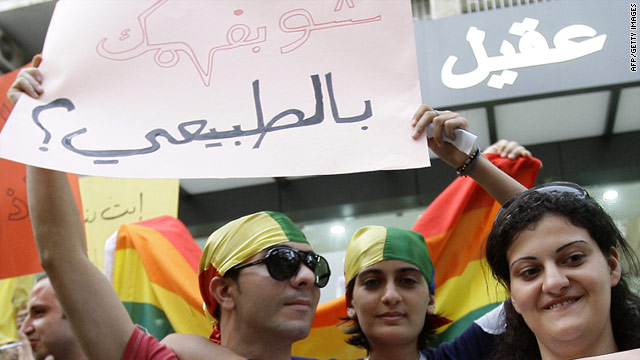
Protesters in Beirut, Lebanon,
on International Day Against
Homophobia 2010.  Their banner reads
"What do you know about being normal?"
"For example, in Egypt and Tunisia there was a lot of hope initially that there would be a more tolerant civil society. Now it seems that the impetus for change will be hijacked by conservative forces who will make the situation worse for gay people and other minorities.

"In Syria and other countries, there's a fear that gay people could be used as sacrificial lambs."

One gay American who recently left Syria, where he had been working for several years, said the unrest had made life more dangerous for gay people.

The man, who spoke to CNN on condition of anonymity, said: "It has caused even more skepticism and paranoia for the gay population -- just another reason to be harassed and checked."

Bertho Makso, owner of a gay-friendly travel company in Beirut, said homosexuals in Lebanon had more freedom than those elsewhere in the Middle East.

He said: "As long as religion has a big impact on governments around the Arab world, it will always be this way."

A 35-year-old gay activist in Dubai, United Arab Emirates, who also spoke to CNN on condition of anonymity, said: "Being gay in U.A.E. is keeping yourself discreet and hiding your inner self. One has to be very careful when in public to not draw any attention towards himself in order not to be harassed.

"The political changes occurring in the Middle East are on a political level only and have not resulted in any society changes. All the gay websites are blocked in U.A.E."

Source: CNN, June 13, 2011

Related article:

Jun 02, 2010
"Compared to last year's report, where we listed the 77 countries prosecuting people on ground of their sexual orientation, this year you will find 'only' 76 in the same list, including the infamous 5 which put people to ...
http://deathpenaltynews.blogspot.com/
_________________________
Use the tags below or the search engine at the top of this page to find updates, older or related articles on this Website.

Wednesday, April 27, 2011

Syria opposition demands reform, vows protests

http://news-updations.blogspot.com/

Syrian resistance figures said Wednesday their "massive waged people revolution" will break the regime unless President Bashar Assad leads a change to democratic state, even as authorities intensify their onslaught on the country's rebellion.

The announcement from an umbrella group of opposition activists in Syria and overseas called the National Initiative for Change said a elected conversion will "safeguard the nation from falling into a period of violent behavior, chaos and civil war."

"If the Syrian president does not wish to be evidenced in history as a leader of this transition period, there is no alternative left for Syrians apart from to move onward along the same path as did the Tunisians, Egyptians and Libyans before them," the declaration said.

Tuesday, April 26, 2011

Thousands of Syrian troops raid rebellious city

http://news-updations.blogspot.com/

Thousands of soldiers backed by tanks and snipers moved in previous to dawn to the city where Syria's anti-government rebellion began, reasoning panic in the streets when they opened fire haphazardly on civilians and went house-to-house rounding up supposed protesters. At least 11 people were killed and 14 others lay in the streets — either dead or grimly wounded, witnesses said.

The military raids on the southern city of Daraa and at least two other areas optional Syria is trying to impose military control on the centers of protest in opposition to President Bashar Assad, whose family has ruled Syria for four decades. Residents and human rights activists said the command wants to terrify opponents and frighten them from staging any more exhibitions.

The disgusting was painstakingly planned: Electricity, water and mobile phone services were cut. Security agents armed with guns and knives conduct house-to-house sweeps, neighborhoods were sectioned off and checkpoints were erect previous to the sun rose.

Full Story

Monday, April 25, 2011

5 killed in new Syria clashes, witnesses say

http://news-updations.blogspot.com/

Syria sharply raise its already lethal campaign to crush a five-week uprising near the beginning Monday, sending troops backed by tanks, snipers and knife-wielding security forces into the southern city where the revolt began. At least five people were killed and dozens arrested, witnesses and activist said.

The offensive into Daraa was the most intense in a sequence of actions to put down dissent and come into view part of new plan for pre-emptive strikes against the antagonism to President Bashar Assad's regime rather than react to marches and protests.

More than 300 people have been killed transversely the country since the uprising began. But the harsh crackdowns have only served to bolster protesters, who started with calls for reserved reforms but are now gradually more demanding Assad's downfall.

Saturday, June 19, 2010

World opinion condemns the US for a 'savage' execution

Around the world and across the US, the firing squad execution in Utah has been met with a wave of criticism from those entirely opposed to the death penalty and those who say that shooting is not the most humane method of killing a prisoner.

In Salt Lake City, opponents held a multi-faith vigil. "I think we do not prefer to be associated with Iran, China, Saudi Arabia and the other countries who use the death penalty as we have used it," Nancy Appleby, chairwoman of the Utah Episcopal Diocese Peace and Justice Commission.

Rev Tom Goldsmith of the First Unitarian Church agreed: "Murdering the murderer doesn't create justice or settle any score." Bishop John Wester added: "The firing squad is archaic, violent and simply expands on the violence that we already experience from guns as a society."

Civil rights organisations in the US also joined the chorus of opposition. "Gardner's execution was both savage and inhumane and highlights the systemic injustices that plague the entire death penalty system in Utah and the rest of the United States," said John Holdridge, director of the American Civil Liberties Union. "Such arbitrary and discriminatory administration of the death penalty is the very definition of a failed system."

The USA has carried out 28 executions so far this year, and 1,216 since resuming judicial killing in 1977. Utah accounts for six of these executions.

Amnesty International, which has long called for a worldwide repeal of the death penalty, said shooting had also been used in China, Libya, Syria, Yemen and Vietnam this past year.

But that may no longer be the case in Vietnam. The day before Gardner was killed, legislators there voted to end the use of firing squad and make lethal injection the only method for executions. The change is due to take effect next year.

Vietnam has long been criticised for the number of death sentences if imposes. About 100 people are executed each year in Vietnam, many for drug-related crimes.

The decision to switch to lethal injection came after a parliamentary committee said it was necessary to find a more humane method.

Amnesty International said it "opposes the death penalty, in all cases and in all countries, regardless of the method used to kill the prisoner, or the nature of the crime for which he or she was sentenced to death."

Source: The Independent, June 19, 2010

Wednesday, March 31, 2010

North Africa: Not Quite Islamic Executions

The Middle East leads the world in executions after China, says an annual Amnesty International report released Tuesday.

"The Middle East and North Africa have the highest per capita rate of executions in the world, according to our figures," Phillip Luther, deputy director for the region with Amnesty, tells IPS.

The Middle East: must be Islam then, most people would imagine. Wrong.

"If you take Egypt, or Syria, or Yemen, or Iraq, the vast majority of death sentences and executions carried out in those countries have nothing to do with Islamic law in any sense," says Luther. "They are on the basis of civil codes - often inherited, and the death penalty provisions within it - from the previous colonial period." Most executions are carried out under the penal code for offences related to drugs and violent crimes, Luther says.

So are executions in non-Islamic countries such as the U.S. and India, to say nothing of China, which is believed to execute thousands a year that it lets the world know nothing about. And Amnesty acknowledges as much, challenging China this year to produce a figure rather than guessing one of its own.

But religion is not behind most executions in the Islamic world of the Middle East and North Africa - and not even in countries such as Saudi Arabia and Iran, says Luther. "If you look at the majority of those sentenced and executed (in Saudi Arabia and Iran), they are executed on the basis of penal codes. Those sentenced under Islamic law are very few."

In Iran, many have been charged with enmity against god, "which clearly has a religious sanction," says Luther, "but which is used in a political way against people who are perceived by the state of rebelling against the state." The motives in Iran are more political than religious because among those executed are a disproportionate number of political prisoners, or members of ethnic or religious minorities.

The sanction comes in the name of religion, but is basically a handle used by the state for its own political ends, and not because it's out to create Islam justice in society.

Amnesty International recorded 388 executions in Iran last year, but says the true figure could be higher. "At least 14 executions took place in public," the report says. "In one 8-week period between the presidential election on Jun. 12 and the inauguration of Mahmoud Ahmadinejad for a second term as President on Aug. 5, Amnesty International recorded 112 executions; by contrast, in the 5 1/2 months between Jan. 1 and Jun. 12, at least 196 executions had taken place."

Many countries within the region such as Algeria, Morocco, Tunisia and Lebanon have maintained a long-term moratorium on the death penalty of at least 10 years.

The Amnesty report lists 624 executions across the Middle East and North Africa last year. There are no definite figures over earlier years to compare this with, but the general trend in the region is downward, says Luther. "Only 7 countries in this region carried out executions last year (Egypt, Iran, Iraq, Libya, Saudi Arabia, Syria and Yemen). In terms of the number of countries, that trend is going down, as it is across the world as a whole."

At the same time there is a louder legislative debate in many of these countries to at least reduce the number of crimes punishable by death. "In Lebanon the ministry of justice itself is campaigning to end the death penalty," says Luther. "Algeria was one of the co-sponsors in the U.N. General Assembly in 2008 for a call for a global moratorium, the first Middle East or North African state to do so."

But even though executions are carried out mostly under the penal code, they are at their highest in Iran and Saudi Arabia. "In Saudi Arabia, the authorities continued to execute at an alarming rate," the Amnesty report says. "At least 69 people were publicly beheaded during 2009.

"At the end of 2009 Amnesty International knew of at least 141 people on death row in Saudi Arabia, including at least 104 foreign nationals, mostly from developing countries in Africa, Asia and the Middle East. Prisoners are sentenced in largely secret and unfair trials, often without a defence lawyer, and so the true figures for those under sentence of death are believed to be much higher."

Source: All Africa News, March 31, 2010

Monday, February 15, 2010

West challenges Iran over 'bloody repression'

Western powers accused Tehran of waging "bloody repression" since elections last year as they challenged Iran to open up to international scrutiny during a UN human rights meeting Monday.

In a public review of Iran's record at the UN Human Rights Council, Britain, France, the United States and other Western nations expressed deep concern about reports of killings, arrests and torture in a clampdown on dissent.

"The authorities are waging bloody repression against their own people, who are peacefully claiming their rights," French ambassador Jean Baptiste Mattei said.

"France recommends that Iran accept the creation of a credible and independent international inquiry mechanism to shed light on these violations," he told the Council.

Senior Iranian official Mohammad Javad Larijani rejected a "barrage of accusations" and accused some Western nations of "double standards" following their support for repression under the Shah of Iran.

"Definitely there is problem of credibility," said Larijani, secretary general of Iran's High Council for Human Rights.

The United States and Britain called on Iran to open up to visits by the United Nations investigator on torture as well as other human rights experts, who have failed to get into the country since 2005.

Despite Iran's stated commitments to uphold fundamental freedoms, "grave human rights violations continue to be committed," said British ambassador Peter Gooderham.

They also urged a halt to executions of child offenders, "disproportionate use" of the death penalty against political opponents, violence against women, discrimination and a clampdown on free speech.

President Mahmoud Ahmadinejad's disputed re-election last June plunged the Islamic republic into one of its worst ever political crises, with the opposition refusing to take the fight off the streets despite often deadly crackdowns on protests.

Backed by Cuba, Syria and Venezuela, Larijani defended Tehran's legal safeguards and accused foreign nations of supporting "terrorist" groups on its borders.

"With the victory of the Islamic revolution, the situation of human rights has consistently been used as a political tool to apply pressure against us and to advance certain ulterior political motives by some specific Western countries," Larijani told the UN Council.

Iranian officials also highlighted steps to improve women's access to education, health and social status, and to protect children as well as the representation of religious minorities, and bolster courts.

"The Iranian society is a successful model of brotherly and amicable coexistence," Larijani noted, claiming cultural or religious differences with some Western values.

"We're not claiming that there's no wrongdoing in Iran," he added.

Russia some non-aligned and Islamic nations gave qualified backing, noting progress in social and economic rights while calling on Tehran to "continue to improve" human rights.

US Assistant Secretary for Democracy and Human Rights Michael Posner said after the debate ended that Washington would see that the recommendations were followed through.

"It is not a question of cultural differences that people are being tortured... or shot in the streets," Posner told journalists.

"The challenge is that the presentation flies in the face of what is happening on the ground," he added.

All UN member states must submit to a four-yearly review by the 47 countries in the Human Rights Council, which can only compile recommendations.

US Secretary of State Hillary Clinton said on Monday that she feared Iran was moving towards a military dictatorship.

Source: Agence France-Presse, Feb. 15, 2010


Clinton Cites U.S. Concerns of Military Power in Iran

DOHA, Qatar — Secretary of State Hillary Rodham Clinton said on Monday that the United States feared Iran was drifting toward a military dictatorship, with the Islamic Revolutionary Guards Corps seizing control of large swaths of Iran’s political, military, and economic establishment.

“That is how we see it,” Mrs. Clinton said in a televised town hall meeting of students at the Doha campus of Carnegie Mellon University. “We see that the government in Iran, the supreme leader, the president, the Parliament, is being supplanted and that Iran is moving towards a military dictatorship.”

Click here to read this feature in full.

Source: The New York Times, Feb. 15, 2010

Wednesday, October 7, 2009

Syria: two public hangings

October 6, 2009: two men were hanged on September 3 in Aleppo, Syria, for armed robbery and murder, according to a foreign witness.

An Italian tourist who was in Syria in September with an organised tour group told Hands Off Cain: “I don’t remember exactly when I arrived in Aleppo, but it seems like it was September 3rd. Traveling to the hotel by bus, I saw a gathering of people in a square not far away and I glimpsed people hanging from the gallows in the crowd.”

“I asked information from the tour guide about the place. Embarrassed, he told me that they were hanging two men,” the source who preferred to remain anonymous said.

“I asked why they were sentenced to death and the guide told me the two recently robbed and murdered an elderly couple in the city,” the Italian tourist, whose identity and reliability is certain to Hands Off Cain, said.

“After the executions, the bodies remained hanging as a warning to the people. I’m not certain for how long, if it was for a day or longer,” the witness explained.

In Syria, executions are kept totally secret. News doesn’t filter into local papers or even to relatives. When the bodies are returned to relatives, they don’t know if their loved ones died by torture or by execution.

In 2008, there was at least one execution in Syria, while in 2007 there were at least seven.

Source: Hands Off Cain, 06/10/2009

Saturday, September 8, 2007

La peine de mort en Asie

La fusillade ou le peloton d'exécution

C'est la méthode d'exécution la plus répandue en Chine. On y fusille chaque année des milliers de personnes pour des raisons qui peuvent être le meurtre, l'évasion fiscale, les jeux de hasard, la bigamie, la vente de peaux de panda géant, le vol de vache, la piraterie informatique et beaucoup d'autres.

A l'occasion, on sort également les fusils dans quelques autres pays asiatiques, notamment en Libye, Syrie, Indonésie, Corée du Nord, au Tadjikistan et à Barheïn.

En Indonésie, le condamné reçoit la nouvelle de son exécution 72h à l'avance. Le jour J, il s'avance face au peloton d'exécution cagoulé et habillé de vêtements blancs. Sur son torse est peinte une croix rouge indiquant l'emplacement du coeur. Sur les quatorze fusils utilisés, deux sont chargés à blanc. Quand le vacarme cesse, un médecin contrôle que le corps criblé de balles ne donne plus signe de vie. S'il n'est pas tout à fait mort une balle dans la tête l'achèvera.

La fusillade par peloton d'exécution est sans doute la plus connue à travers le monde mais elle n'est pas la seule.

En Chine, par exemple, on utilise une toute autre méthode. Place au spectacle. Comme l'animal d'un cirque qui débarquerait en ville, le condamné est exhibé en camion, parfois durant des heures, devant la population de la ville. Le cortège s'arrête devant les grilles du stade où l'exécution aura lieu et dans lequel tout le monde pourra suivre la cérémonie comme un bon match. Des tribunes d'honneurs sont même réservées aux officiels. La foule hurle pendant que des haut-parleurs diffusent de la musique et énumèrent les crimes du ou des condamnés. Le criminel porte une pancarte avec son nom barré autour du cou ; avant même l'exécution on le raye du monde des vivants. Il a les poignets et les chevilles liés ou menottés et attend à genoux, la tête baissée. Sa vie lui sera ôtée d'une seule balle de fusil ou de revolver, à bout portant dans la nuque. Une seule balle, non pas par mesure d'économie mais plus certainement pour ne pas endommager ses organes qui seront revendus à des patients fortunés en attente d'une greffe. La famille apprend la mort du proche par courrier après l'exécution. Dans l'enveloppe contenant la missive, on trouve également la douille de la balle qui a tué, les liens qui serraient les poignets du défunt et une facture de 80 yuans (8 euros) pour "frais d'exécution".

Notons également la variante russe de la fusillade, à l'époque où la peine de mort était encore maintenue par Moscou, qui consistait à tirer une balle dans la tête du prisonnier, dans sa cellule et par surprise.

L'injection létale

Cette recette américaine pour tuer sans douleur (ce qui est actuellement contesté par de nombreuses associations, dont des associations de médecins anesthésistes américaines) a débarqué en Asie il y a quelques années.

On l'utilise en Chine et à Taiwan depuis 1997 et plus récemment encore au Vietnam et en Thaïlande où la piqûre a remplacé le fusil du peloton d'exécution.

Le condamné est installé sur une table ou un grand fauteuil matelassé. Une dizaine de sangles de cuir le retiennent fermement par les bras, les jambes, le tronc et la gorge. On lui place une ou plusieurs perfusions dans le bras. Elles serviront à injecter les différents produits qui, successivement, l'endormiront, le paralyseront et l'achèveront. La première injection de thiopental sodique endort le condamné. La seconde injection paralyse ses muscles et ses poumons à l'aide de bromure de pancuronium. La troisième et dernière injection, à base de chlorure de potassium, provoque un arrêt cardiaque.

Là, c'est la version de luxe ; parfois les conditions d'exécutions sont un peu moins "humaines". Lorsque l'opération est parfaitement réussie, elle ne dure que quelques minutes et le condamné ne ressent théoriquement aucune douleur. Cependant, on ne peut pas être sûr que la personne ne souffre pas puisque la paralysie musculaire empêche le corps d'exprimer sa souffrance. Parfois il arrive que les produits ne soient pas bien injectés ou ne fassent pas effet correctement. On a déjà vu des condamnés pris de convulsions ou des exécutions s'éternisant près d'une heure et demie.

La décapitation au sabre

En Asie, la peine capitale par décapitation est reconnue par le Qatar, le Yemen et l'Arabie Saoudite mais seule cette dernière l'utilise réellement. On l'utilise pour punir le meurtre, le viol, le trafic de drogue, le vol à main armée, la sodomie et quelques autres crimes.

On compte plusieurs décapitations au sabre chaque année en Arabie Saoudite, principalement pour punir le meurtre et le trafic de drogue. On exécute aussi bien les hommes que les femmes. Après quelques prières, le condamné est conduit par des policiers sur une place publique. On lui a administré des tranquillisants, il a les yeux bandés et les mains attachées dans le dos. Sur une grande bâche en plastique, devant un gouttière destinée à recueillir le sang, on le force à s'agenouiller. Dans cette position il entend son nom et les crimes lui étant reprochés qui sont lus à la foule. L'officier de police chargé de l'exécution lui assène un coup sur la tête pour l'obliger à dévoiler sa nuque. Dans son dos, le condamné entend le bruit d'une lame qui fend l'air à plusieurs reprises. Le policier s'échauffe les muscles en mimant le geste fatal avec son cimeterre, grand sabre courbé à simple tranchant. Puis c'est la délivrance : après un coup net, la tête se détache et roule sur le sol. Immédiatement, un médecin la ramasse et stoppe le jet de sang qui gicle de la nuque. Le corps est enroulé dans le plastique et transporté en ambulance. Il sera enterré dans le cimetière de la prison, sous une pierre tombale sans nom.

La pendaison

C'est la méthode employée dans le plus de pays. On l'utilise aussi bien au Japon, en Afghanistan, Arabie Saoudite, Corée du Nord, Inde, Iran, Malaisie, au Koweit, au Soudan et à Singapour. Mais c'est en Irak que les bourreaux ont le plus de travail car la trappe sous les pieds des condamnés à mort s'est ouverte un nombre record de fois sous le régime de Saddam Hussein et continue encore de s'ouvrir sous les pieds du dictateur et ses proches.

Il y a deux grands modèles de pendaison. La pendaison par précipitation ou la pendaison par étouffement.

La pendaison par précipitation, ou long-drop, est la méthode la plus courante. Le condamné est précipité depuis une hauteur où un mécanisme de trappe s'ouvre sous ses pieds. Les vertèbres se disloquent et le criminel meurt sur le coup. La position du noeud de la corde et surtout la longueur de cette dernière sont très importantes. Une corde trop courte ou un noeud placé sur le côté du cou et le condamné meurt par strangulation. Une corde trop longue et c'est la décapitation.

En Iran, par contre, on préfère utiliser une autre méthode qui consiste à soulever la corde progressivement à l'aide d'une grue télescopique. Le corps se soulève petit à petit vers le haut et le condamné meurt étouffé après s'être longuement débattu. En 2004, une jeune fille de 16 ans a été pendue pour « actes incompatibles avec la chasteté ». En 2005, deux adolescents de 15 ans et 17 ans ont été pendus pour viol et homosexualité.

Précisons également que c'est Singapour qui détient le record du nombre de pendaisons par habitant avec 420 exécutions entre 1991 et 2004 pour un total de 4.4 millions d'habitants. Là-bas, le trafic de drogue en particulier est sévèrement puni.

Enfin soulignons l'originalité des Talibans en Afghanistan qui pendent parfois des criminels à la barre transversale des buts durant les matchs de football. Certaines images à la limite du supportable de ces scènes avaient d'ailleurs été véhiculées par tous les médias, il y a de ça quelques années déjà.

La lapidation

Sans doute la méthode d'exécution la plus violente et la plus insupportable. On lapide principalement dans des pays islamiques gouvernés par la charia. Surtout en Iran mais aussi en Arabie Saoudite, en Afghanistan, au Pakistan, au Soudan et aux Emirats Arabes Unis. Des lapidations ont également eu lieu au Népal mais pas en tant que peines capitales infligées par la justice d'un pays.

48h environ après le verdict, le condamné est amené sur la scène de son exécution. Il est enterré jusqu'au niveau du buste, les bras le long du corps. À une distance assez proche, la foule lui lance violemment des pierres de la taille d'un poing jusqu'à ce que mort s'en suive. Le code pénal iranien, en ses articles 102 et 104, va même jusqu'à préciser la taille idéale des pierres et de quelle façon ainsi qu'à quelle distance on doit les lancer: « Les pierres utilisées pour infliger la mort par lapidation ne devront pas être grosses au point que le condamné meure après en avoir reçu une ou deux. Elles ne devront pas non plus être si petites qu'on ne puisse leur donner le nom de pierre. La taille moyenne est choisie généralement afin de faire expier la faute par la souffrance ». « Les lapideurs doivent rester à distance d’une quinzaine de mètres de leur cible et choisir avec soin leurs pierres : les pierres coupantes sont choisies pour leurs arrêtes effilées qui provoquent les saignements les plus spectaculaires. Une pierre coupante doit de préférence être lancée au visage du condamné. Les pierres rondes nécessitent moins de précision car elles sont efficaces partout. Elles sont idéales pour briser les os et provoquer les hémorragies internes fatales ». Les victimes de lapidations sont en grande majorité des femmes, condamnées pour des crimes comme l'adultère ou la prostitution et parfois même pour un viol dont elles ont été victimes ou simplement le fait de parler à un autre homme que son mari. Une enfant de 13 ans a par exemple été condamnée à la lapidation pour être tombée enceinte suite à des rapports sexuels avec son frère de 12 ans.

Selon l'ONU, environ 5000 femmes et filles sont exécutées chaque année par leurs proches pour des "crimes d'honneur".

Source : Ici-Asie.com