Showing posts with label Lebanon. Show all posts

Thursday, December 19, 2013

Egypt: Mohammed Morsi faces terror charges and death penalty

Former Egypt President Mohammed Morsi, ousted in July by a military coup and subsequently jailed by the now-ruling government, faces terror charges that carry the death penalty.

He is accused of conspiring with Hamas, the Palestinian terrorist group, as well as with Hezbollah, the militant organization that’s tied to Lebanon and maintains a strong presence in the Gaza, the Belfast Telegraph reported.

Prosecutors say that he and his aide revealed government secrets to these groups — as well as to members of Iran’s Revolutionary Guard. And they’re also accusing the former president and several leading Muslim Brotherhood figures with not only sponsoring terrorism, but also carrying out combat training for supporters that were aimed at upsetting Egypt’s stability, the Belfast Telegraph said.

A trial date has yet to be set.

But Mr. Morsi already faces charges of inciting murder against his political opponents while he held the high office. That trial continues in January.

But these latest allegations could lead to a death penalty against the beleaguered former leader — and another political and public relations hit against the Muslim Brotherhood, which was already booted from the nation when the interim government took power. Prosecutors said in the Belfast Telegraph that the Brotherhood has been involved in an international campaign to create chaos in Egypt, and forged a terrorist plot — supported by Mr. Morsi — to smuggle weapons into the country and members into the Gaza Strip for military training with Hezbollah and Iran Revolutionary Guard members.

Source: Washington Times, December 18, 2013

Tuesday, October 23, 2012

Morocco: Former death row inmates speak out at abolition forum

Former convicts on death row in the Middle East and North Africa described awaiting their dreaded fate as "daily torture" from which execution itself was a "deliverance," at an abolition conference in Rabat.

"I spent 10 years on death row in Morocco, and the hardest thing was the wait," Ahmed Hamou told AFP at the three-day conference, which brought together hundreds of officials and civil society representatives from the MENA region.

"In Section B, which is the death row ward at Kenitra prison (40 kilometres north of Rabat), a terrible silence prevails. At the smallest sound, your heart beats faster and you say to yourself: 'That's it. The time has come."

Arrested on political charges in 1983 in Casablanca, at a time when Morocco's largest city was experiencing widespread social unrest, Haou was sentenced to death the following year.

In 1994, under international pressure, he was pardoned by the late king Hassan II, father of the present monarch, Mohammed VI.

"In other wings of the prison, the opening of a cell door is synonymous with hope and freedom. But on death row, it can spell the end and creates an indescribable fear," said Haou, who described his ordeal at the Rabat conference.

"So the wait is like daily torture, and as you wait, execution itself comes to mean deliverance," he said.

A moratorium on executions in Morocco has been in place since 1993, but around 100 convicts remain on death row, with no Arab country having yet abolished capital punishment.

The French ambassador on human rights, Francois Zimery, argued that the north African kingdom was able to play a pioneering role on the issue, pointing to the peaceful atmosphere of the conference, the 1st of its kind.

In their efforts to see the death penalty outlawed, local NGOs also refer to Morocco's new constitution, adopted by referendum last year, which stipulates "the right to life."

Antoinette Chahine, a Lebanese former death row inmate participating in the abolition conference, spoke of her two years in prison in Beirut, after she was wrongly convicted of murder in 1997 and sentenced to death.

"Women sentenced to death in Lebanon are not executed, but no law explicitly mentions that," she told AFP.

"But in spite of that, the wait was terrible, until I was acquitted by the court," Chahine said.

"The uncertainty makes every moment an unbearable form of torture. If I had been executed, the judiciary would have killed an innocent person. That's why I have devoted myself to abolishing the death penalty," she added.

French ambassador Zimery also spoke of the "human realities" involved, and stressed that having a moratorium in place "means there are people on death row, who suffer from the torture and uncertainty of the next day."

France has launched an international campaign, and has urged Morocco to take the lead in being the first Arab country to do away with the death penalty.

According to Amnesty International, the MENA region has the highest execution rate in the world relative to the size of its population.

Source: Agence France-Presse, October 22, 2012

Wednesday, May 30, 2012

URGENT APPEAL for Lebanese man with history of mental illness due to be executed in Ohio on 6 June

A Lebanese national with a history of mental illness is due to be executed in the US state of Ohio on 6 June for a double murder committed in 1992. The parole board has recommended to the governor that he deny clemency; he is not bound by their decision.

Abdul Hamin Awkal, who arrived in the USA at the age of 24 in 1984 from Lebanon, was sentenced to death for the murder in 1992 of his wife Latife Awkal, who was seeking a divorce from him, and her brother Mahmoud Abdul-Aziz. The two were shot dead in the Family Conciliation Services Department of a Domestic Relations Court in Cleveland, Ohio, on 7 January 1992. Abdul Awkal was arrested in the courthouse after the shooting. In pre-trial custody Abdul Awkal was prescribed anti-psychotic and anti-depressant medications. The trial judge found that the severity of his depression rendered him incapable of assisting in his defense and that he was therefore not competent to stand trial. Abdul Awkal was held in a psychiatric facility where his anti-psychotic medication was increased, and he was then found competent to stand trial. During the trial in late 1992, his lawyers told the judge that his mental health had deteriorated, but the judge rejected their suggestion to hold a new competency hearing. Abdul Awkal was sentenced to death. One of the jurors has since signed a statement that he would have voted for life imprisonment without the possibility of parole if that had been an option at the time of the trial.

At a hearing before the Ohio Parole Board on 10 May 2012, Abdul Awkal's lawyers presented evidence of his traumatic experiences in the civil war in Lebanon which began in 1975 when he was 16, and his history of mental illness including severe depressive and delusional disorders. Psychiatrist Dr Phillip Resnick said that in 2005, 2007 and 2012 he had diagnosed Abdul Awkal as suffering from schizoaffective disorder, a serious mental condition combining psychosis and mood disorder, and detailed his "grandiose and persecutorial delusions." In a letter to Governor John Kasich, one of his lawyers has written: "Abdul Awkal lives in a delusional world" in which he believes he has "directed wars in Iraq and Afghanistan", "advises high-ranking government officials by mail", receiving coded messages in reply, and that "the CIA wants him dead" because he is "not helping them anymore".

The parole board acknowledged that "Awkal suffers from Schizoaffective Disorder, Depressive Type", but voted 8-1 that the aggravating factors in the case outweighed the mitigating circumstances. The member voting for clemency found that Abdul Awkal's mental state during the trial "was tenuous at best", that his illness might have affected his decision to reject the prosecutor's offer of a life prison term in return for a guilty plea, and that his crime had arisen "out of anger exacerbated by his mental illness – delusions of persecution – and his childhood exposure '…where guns and death were an everyday occurrence'." She also raised the poor quality of his legal representation at trial.

Please write immediately, in English or your own language:
-Explaining that you are not seeking to excuse these murders or to downplay the suffering caused;
-Noting that abdul awkal has repeatedly been diagnosed with serious mental illness;
-Noting the poor legal representation abdul awkal received at trial;
-Opposing the execution of abdul awkal and calling on the governor to grant him clemency.

PLEASE SEND APPEALS BEFORE 6 JUNE 2012 TO:
Governor of Ohio
John Kasich
Riffe Center, 30th Floor, 77 South High Street
Columbus, OH 43215-6117
Fax: 1 614 466 9354
(governor's Deputy Legal Counsel, adviser on clemency, please ask for your email to be forwarded)
Salutation: Dear Governor

Please check with the AIUSA Urgent Action Office if sending appeals after the above date.

ADDITIONAL INFORMATION
In 2009, a three-judge panel of the US Court of Appeals for the Sixth Circuit decided that Abdul Awkal should receive a new trial on the grounds of ineffective assistance of counsel at the original trial at which he had pleaded not guilty by reason of insanity. His lawyer had attempted to present three expert witnesses in support of this defense. The judge found that the first was not a licensed psychologist and therefore excluded his testimony. The second, a court-appointed forensic psychiatrist, testified that he believed Abdul Awkal had been sane at the time of the murders. The third had been practicing psychiatry for about a year, but was not yet certified. The Sixth Circuit panel found that "clearly, Abdul Awkal's counsel's selection of guilt-phase experts was far less than ideal" and that the decision to call the forensic psychiatrist to testify amounted to constitutionally deficient performance.

The state appealed for a rehearing by the full Sixth Circuit. In 2010, the full court reversed the panel decision. Four of the 14 judges dissented: "Any remotely competent attorney knows that an insanity defense relies mainly upon expert testimony regarding the defendant's mental state. But Abdul Awkal's counsel's presentation of expert psychological testimony at the guilt phase sounds like the opening of a bad joke: 'Three defense experts walk into court. One got his degree from a mail-in university, is not licensed, and cannot testify. One is well-credentialed but testifies against the defendant. And the third is not certified in psychiatry. Or perhaps the better analogy is an episode of [the farce act] The Three Stooges. But, however one wishes to describe it, it is clear what counsel's performance was not: the kind of representation constitutionally required in a capital case."

Ohio has become one of the USA's leading death penalty states, having carried out eight per cent of US executions in the past decade (45 out of 546 since January 2002). This has happened at a time when the country appears to be turning against the death penalty. In 2012, Connecticut became the fourth US state in five years to legislate to abolish capital punishment – after New Jersey (2007), New Mexico (2009) and Illinois (2010) – in addition to the demise of the death penalty in New York State. There has been a two-thirds reduction in annual death sentences in the USA since the mid-1990s, a halving in the annual judicial death toll since 1999, and the removal by the US Supreme Court of children (2005) and people with "mental retardation" (2002) from the reach of the executioner. In 2011, the Oregon governor imposed a moratorium on executions, and some 800,000 citizens in California – the state which accounts for one in five of the USA's death row inmates – have endorsed putting abolition to the popular vote. As a result the choice to repeal the death penalty will be on the ballot for California voters at the general election on 6 November 2012. If the initiative is passed, the state's death penalty will be replaced by life imprisonment without the possibility of parole, and a fund of US$100 million will be created for use by law enforcement agencies in investigating murders and rape. This is a very different national picture from when Ohio carried out its first execution in 1999.

In January 2011, Senior Ohio Supreme Court Justice Paul Pfeifer, who when he was a state legislator was a co-author of Ohio's capital statute enacted in 1981, wrote: "I helped craft the law, and I have helped enforce it. From my rather unique perspective, I have come to the conclusion that we are not well served by our ongoing attachment to capital punishment… I ask: do we want our state government – and thus, by extension, all of us – to be in the business of taking lives in what amounts to a death lottery? I can't imagine that's something about which most of us feel comfortable. And, thus, I believe the time has come to abolish the death penalty in Ohio."

Amnesty International opposes the death penalty in all cases, unconditionally. There have been 1,295 executions in the USA since judicial killing resumed there in 1977, including 47 in Ohio. There have been 18 executions so far in 2012, one in Ohio.

Name: Abdul Hamin Awkal (m)
Issue: Death penalty, Health concern
---------------------------------
** POSTAGE RATES **

Within the United States:
$0.32 - Postcards
$0.45 - Letters and Cards (up to 1 oz.)
To Canada:
$0.85 - Postcards
$0.85 - Airmail Letters and Cards (up to 1 oz.)
To Mexico:
$0.85 - Postcards
$0.85 - Airmail Letters and Cards (up to 1 oz.)
To all other destination countries:
$1.05 - Postcards
$1.05 - Airmail Letters and Cards (up to 1 oz.)

Amnesty International is a worldwide grassroots movement that promotes and defends human rights.

This Urgent Action may be reposted if kept intact, including contact information and stop action date (if applicable). Thank you for your help with this appeal.

Urgent Action Network
Amnesty International USA
600 Pennsylvania Ave SE 5th fl
Washington DC 20003
Phone: 202.509.8193
Fax: 202.675.8566
----------------------------------
END OF URGENT ACTION APPEAL

Friday, February 24, 2012

Death for 3 Lebanese who spied for Israel: judiciary

3 Lebanese were sentenced to death by a military court on Friday for spying for Israel, a judicial source said.

The tribunal "condemned to death Mussa Ali Mussa, who was found guilty of having contacted the Israeli enemy and passing on information," the source said.

The court found that Mussa had passed on to the Jewish state between 2000 and 2010 "information on officials from Hezbollah," the powerful Lebanese Shiite group.

The court also condemned to death in absentia Ali Sweid and Ahmed Hussein Abdullah on charges of spying for Israel.

Lebanese authorities in 2009 launched a national crackdown on alleged Israeli espionage rings. Lebanon and Israel remain technically in a state of war and convicted spies can face the death penalty.

More than 100 people have been arrested on suspicion of collaborating with Israel's Mossad spy agency, including an army general, members of the security forces and telecoms employees.

Several people have so far been sentenced to death, including one found guilty of helping Israel during its devastating 2006 war with arch-enemy Hezbollah. However, none of the death sentences has yet been carried out.

Source: The Daily Star, Feb. 24, 2012

Tuesday, February 21, 2012

Lebanon: No life or death sentence reductions under new law

Inmates sentenced to life in prison or to death will not benefit from a draft law that reduces prison sentences from a year to nine months, the chair of Parliament’s Justice and Administration Committee said Monday.

After a committee meeting in advance of Wednesday’s legislative session, during which Parliament is set to vote on the new penal law and a number of other issues, MP Robert Ghanem said inmates sentenced to less than one year will also have their sentences reduced.

“A prison year in general would become nine months, for those who have sentences of less than one year, every month would be counted as 20 days,” Ghanem told reporters after he chaired a meeting of lawmakers who have been working on the draft law since 2009.

“However, those who are convicted of repeating the same crime for which they had served a sentence before would also not benefit from the new penal law,” Ghanem said.

At least 4 prisoners were killed and nearly 10 were injured at Roumieh prison last spring when rioters in the complex confronted the Internal Security Forces and the Lebanese Army.

Inmates in the country’s prisons and their families have repeatedly protested against poor conditions and overcrowding, staging hunger strikes and protests. In addition to calling for the sentence reduction, prisoners, their families and activists have called for a general amnesty.

To reduce the pressure on the overcrowded Roumieh prison, Lebanon’s largest, Cabinet and Parliament have both held talks on the establishment of new prisons.

Deputy Prime Minister Samir Mokbel announced last week that an agreement had been reached among the Cabinet ministers on the locations of two new prisons, which are to be built in north and south Lebanon.

Ghanem said future verdicts should clearly specify whether a convict has already committed the same offense to avoid any confusion in the implementation of the new law.

“Based on Law 258 of the Penal Code, the verdict must specify whether the convict is repeating a crime,” Ghanem said.

When asked whether Parliament would approve the draft law, Ghanem said reducing the prison year to nine months is part of the new prison policy that Parliament should approve.

He added that after parliamentary approval the policy would be transferred to the Justice Ministry for implementation because the ministry was set to take over prison administration from the ISF in approximately 3 years.

Source: The Daily Star, Feb. 20, 2012


Three sentenced to death for "spying" for Israel

February 17, 2012: Judicial officials say a Lebanese military court convicted a former policeman of spying for Israel and sentenced him to death.

A military court found Haitham al-Sahmarani guilty of giving sensitive security information to Israeli intelligence agents including during a monthlong 2006 war between Israel and the militant Hezbollah group.

The officials said al-Sahmarani's sister and her husband who are believed to be in Israel were also sentenced to death in absentia on similar charges. They spoke on condition of anonymity in line with regulations.

Al-Sahmarani is a former chief sergeant. He was arrested in 2009.

Lebanon and Israel technically remain at war, and more than 100 people in Lebanon have been arrested since 2009 on suspicion of collaborating with the Jewish state.

Source: AP, February 17, 2012

Monday, June 13, 2011

Will gays be 'sacrificial lambs' in Arab Spring?

(CNN) -- The uprisings bringing political change and demonstrations across much of the Arab world have given millions of people hope of greater freedom. But some gay people in the Middle East fear exactly the opposite.

Homosexuality is illegal -- enforced to varying degrees -- in most Arab countries.

A 2011 report by the International Lesbian and Gay Association reported that homosexuality is illegal in 76 countries worldwide and punishable by death in five, including Yemen, Saudi Arabia and Iran.

Despite the risks, there are those willing to speak out and campaign for gay rights across the Middle East.

Sami Hamwi, a 35-year-old journalist from Damascus, is the Syrian editor for the website Gay Middle East, but few friends or family know his true sexual orientation.

Hamwi said: "We have been trying in Gay Middle East to start a group to be able to help LGBT [Lesbian, Gay, Bisexual and Transgender] people in Syria. It is a work in progress."

However, he added: "I am very scared now. I can think of a million things they can do to me if I was ever arrested or investigated."

Hamwi wants to see reform in Syria, but doubts that any political change could significantly improve gay rights.

"Sheikhs still emphasize that death penalty is the Islamic punishment for gay men," he said.

"A more open society regarding sexuality needs years, if not decades, of work after Syrians get the freedom they aspire to have."

Haider Ala Hamoudi, an expert on Middle Eastern and Islamic law at the University of Pittsburgh School of Law, in the United States, says that while Islamic law is open to different interpretations, it is generally considered to condemn homosexuality.

"Not every Muslim would adhere to this view but traditionally Islamic law would regard homosexuality as illegal," he said.

"It seems commonly accepted that the foundational sacred sources (the Quran and the Sunnah) ban homosexuality," he added. "I do know there are Muslims who take exception to that, it's not black and white, but the dominant standing pretty clearly condemns homosexuality."

Dan Littauer, the London-based editor of Gay Middle East, said: "Many gay activists are very scared that the reality of their oppression could get worse.

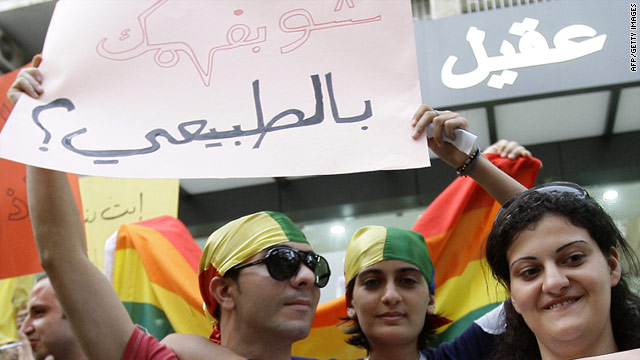
Protesters in Beirut, Lebanon,
on International Day Against
Homophobia 2010.  Their banner reads
"What do you know about being normal?"
"For example, in Egypt and Tunisia there was a lot of hope initially that there would be a more tolerant civil society. Now it seems that the impetus for change will be hijacked by conservative forces who will make the situation worse for gay people and other minorities.

"In Syria and other countries, there's a fear that gay people could be used as sacrificial lambs."

One gay American who recently left Syria, where he had been working for several years, said the unrest had made life more dangerous for gay people.

The man, who spoke to CNN on condition of anonymity, said: "It has caused even more skepticism and paranoia for the gay population -- just another reason to be harassed and checked."

Bertho Makso, owner of a gay-friendly travel company in Beirut, said homosexuals in Lebanon had more freedom than those elsewhere in the Middle East.

He said: "As long as religion has a big impact on governments around the Arab world, it will always be this way."

A 35-year-old gay activist in Dubai, United Arab Emirates, who also spoke to CNN on condition of anonymity, said: "Being gay in U.A.E. is keeping yourself discreet and hiding your inner self. One has to be very careful when in public to not draw any attention towards himself in order not to be harassed.

"The political changes occurring in the Middle East are on a political level only and have not resulted in any society changes. All the gay websites are blocked in U.A.E."

Source: CNN, June 13, 2011

Related article:

Jun 02, 2010
"Compared to last year's report, where we listed the 77 countries prosecuting people on ground of their sexual orientation, this year you will find 'only' 76 in the same list, including the infamous 5 which put people to ...
http://deathpenaltynews.blogspot.com/
_________________________
Use the tags below or the search engine at the top of this page to find updates, older or related articles on this Website.

Thursday, November 11, 2010

Saudi court rejects death for Lebanese 'sorcerer'

A Lebanese television psychic sentenced to death for "sorcery" in Saudi Arabia was granted a stay of execution on Friday, his lawyer told The BBC.

Saudi Arabia's high court has rejected the execution sentence of a Lebanese man convicted of sorcery and recommended that he be deported after a new trial, a newspaper reported Thursday.

The Supreme Court in Riyadh said that the death sentence for Ali Sabat (left) was not warranted because he had not harmed anyone and had no prior offences in the country, Okaz said.

The court said his case should be sent back to a lower court in Medina to be retried and recommended that Sabat, who has spent 30 months in Saudi prison since his May 2008 arrest, be deported, Okaz said.

Sabat, a 46-year-old father of 5, was sentenced to death last November by a Medina court for practising witchcraft, illegal under Saudi Arabia's Islamic sharia law.

He was arrested by the religious police in Medina, where he was on a pilgrimage.

The case against him was brought after he gave advice and made predictions on Lebanese television broadcast to Saudi Arabia via satellite. In October, Amnesty International said it had appealed to King Abdullah in a letter to commute the death sentences for Sabat and Sudanese Abdul Hamid al-Fakki, also sentenced to death for sorcery.

The status of Fakki's case was unknown.

Source: Agence France-Presse, November 11, 2010

Wednesday, July 14, 2010

Lebanon: Court issues death sentence to Lebanese spying for Israel

A Lebanese military court on Tuesday sentenced a man to death for spying for Israel’s Mossad intelligence agency and aiding Israel in a deadly 2006 war against Lebanon, a judicial source said.

"The head of the military court General Nizar Khalil sentenced Ali Hassan Mentesh to death for arms dealing, entering and collaborating with Israel, providing it with information about certain targets," the source said.

Israel "used this information to hit its targets" in 2006 war with Shiite militant group Hizbullah, which killed more than 1,200 Lebanese, mainly civilians, and 160 Israelis, mainly soldiers.

Lebanon and Israel remain technically in a state of war, and convicted spies face life in prison with hard labor or the death penalty if found guilty of contributing to Lebanese loss of life.

Mentesh, 53, hails from the southern area of Nabatieh and was arrested in April last year when Lebanon launched what is an ongoing crackdown on suspected Israeli espionage rings.

Charbel Qazzi, a technician at Lebanon's Alfa mobile phone service provider, was also charged on Tuesday of "entering enemy territory, collaborating with Israel and providing it with information," the source said.

Qazzi, who was arrested last month, also faces the death penalty if convicted.

MP Hassan Fadlallah, a member of Hizbullah and head of Parliament's information and telecommunications committee, said Qazzi had been giving Israel "vital information" on communications and security for 14 years.

Lebanon has arrested more than 70 people since last year on suspicion of spying for Israel, including members of the country’s security forces.

Israel has not commented on the arrests.

Source: Agence France-Presse, July 13, 2010

Friday, April 23, 2010

Saudi Arabia: Laywer says Saudis might pardon Lebanese 'sorcerer'

A Lebanese man who was charged with sorcery and given the death sentence in Saudi Arabia, might get an official pardon from the kingdom, his lawyer said on Friday.

Ali Sibat (pictured), a Lebanese television presenter was arrested in Saudi Arabia in May 2008 while on a pilgrimage to Mecca and found guilty of engaging in "sorcery."

Before his arrest, Sibat, a 49-year-old father of 5, used to work for a now defunct Lebanese satellite television channel where he used to predict the future to callers from around the world.

Saudi Arabia, a devout Muslim country, frowns on witchcraft, black magic and fortunetelling, which it regards as polytheism.

A Saudi court has issued the death sentence to Sabat and a beheading had been scheduled for April 2. But an uproar from Lebanon and a variety of human rights group caused Saudi officials to delay the sentence.

May Khansa, Sibat's Lebanese lawyer, said she was informed by Lebanese Justice Minister Ibrahim Najjar that Sibat's "death sentence might be cancelled."

"We are still waiting, we do not have anything official, but the minister said there will be good news soon," Khansa said.

Most Lebanese consider the decision by the Saudi court to impose the death penalty on a Lebanese national who does not reside in the kingdom or work there to be unfair.

Source: Earth Times, April 23, 2010

Tuesday, April 13, 2010

Lebanon seeks death penalty for alleged Israel spies

A Lebanese military prosecutor was seeking the death penalty for 3 men charged with spying for Israel and the attempted murder by one of them of an Al-Qaida suspect, the French AFP news agency reported on Monday.

Judge Samih al-Hajj charged the two Lebanese and one Palestinian, according to the AFP report, with "providing Israel with information as well as facilitating its aggressions and terrorist acts on Lebanon," according to the charge sheet.

Palestinian Mohammed Ibrahim Awad and Lebanese Robert Edmond Kfoury areboth in custody. The 3rd suspect, Lebanese Elias Riyad Karam, was charged in absentia.

Awad is also suspected with the attempted murder of Naim Abbas, suspected of being a member of an Al-Qaida cell in the Ain al-Helweh refugee camp in Lebanon's south.

Last spring, Lebanon arrested close to 20 alleged members of 6 espionage cells suspected of transmitting intelligence information to Israel. The 2-month crackdown was apparently aided by American training and equipment.

The wave of detentions began in April 2009 with the arrest of a former brigadier general of the General Security directorate.

Senior Lebanese security officials have said the arrests dealt a major blow to Israel's spying networks in Lebanon and that many of the suspects played key roles in identifying Hezbollah targets that were bombed during the 34-day war.

Other suspects have been charged with monitoring senior Hezbollah officials and at least 1 is alleged to have played a role in the 2004 assassination of a commander of the group.

Hezbollah, the Iranian- and Syrian-backed military and political group, has called for the death penalty for all suspects convicted of spying for Israel. Hezbollah and Israel fought a war in 2006.

Source: Ha'aretz, April 12, 2010

Saturday, April 3, 2010

Saudi Arabia Delays Execution of TV 'Sorcerer,' Lawyer Says

A Lebanese television psychic sentenced to death for "sorcery" in Saudi Arabia was granted a stay of execution on Friday, his lawyer told The BBC.

Until he was arrested in 2008 while on a pilgrimage in Saudi Arabia, Ali Sibat (pictured) was the host of a satellite television program in which he promised to give "advice and predictions about the future," to callers from around the Arab world to his studio in Beirut, as Britain's Channel 4 News explained in a report on his case on Thursday.
The television psychic was popular in Saudi Arabia and was reportedly recognized by members of the country's religious police officially known as the Committee for the Promotion of Virtue and the Prevention of Vice.

According to Amnesty International, Mr. Sibat was sentenced to death in Medina in November, "after secret court hearings where he had no legal representation or assistance." The human rights group also reported that "on March 10, a court in Medina upheld the death sentence. The judges said that he deserved to be sentenced to death because he had practiced 'sorcery' publicly for several years before millions of viewers." The court added that his execution would act as a deterrent to what it called the increasing number of "foreign magicians" coming to Saudi Arabia.

May al-Khansa, a lawyer working for Mr. Sibat in Lebanon, raised an alarm about Mr. Sibat's possible execution this week when she said on Wednesday that she had been told he would be beheaded "within 48 hours." On Friday, though, Ms. Khansa told The Associated Press that Lebanon's justice minister had informed her that Mr. Sibat "would not be executed in Saudi Arabia today, the day executions are typically carried out in the kingdom after noon prayers."

Since Saudi authorities do not always give notice of executions, and have not responded to requests for comment from foreign media organizations, the apparent delay in Mr. Sibat's execution has yet to be confirmed.

Ms. Khansa told a BBC radio program that she had been told that he was still alive on Friday, "But after that I dont have an answer as to if he will be alive or not. Time is passing and if they don't kill him this Friday maybe next Friday." In a television interview with the BBC, she appealed to Saudi Arabia's king to recognize that "Ali Sibat is not a criminal."

In Beirut, Meris Lutz of The Los Angeles Times wrote that the case might be more about Saudi politics than law.

One Lebanese legal expert who is familiar with Saudi law and politics described the case against Sibat as a "muscle show" by conservatives who may be seeking to embarrass reformist leaders such as King Abdullah.

"I don't know on what grounds they arrested him, since he didn't commit [the crime] in Saudi, he's not a Saudi citizen, and it wasn't directed against Saudi, and usually one of these criteria must be fulfilled," the expert said, asking that her name not be published because she travels to Saudi Arabia.

Ms. Lutz added that the legal expert suggested that Mr. Sibat might have been given the harshest possible sentence because he is a Shiite Muslim.

Source: New York Times, April 3, 2010

Friday, April 2, 2010

Beheading of Man in Saudi Arabia for Witchcraft Averted - at Least Temporarily

A Lebanese man condemned to death for witchcraft by a Saudi court will not be beheaded Friday as had been expected, his lawyer said.

Ali Hussain Sibat (pictured), the father of five, was to be executed after noon prayers Friday, but a frenzy of media coverage, appeals by international human rights groups and intervention by several Lebanese government officials, may have saved his life, at least temporarily.

His lawyer, May al-Khansa, said she was still unsure whether the beheading had been waived or postponed.

A Shi'ite Muslim, Sibat traveled to Saudi Arabia in 2008 to perform a religious pilgrimage known as 'umra,' when he was arrested by Saudi's religious police who accused him of practicing sorcery. The charges stem from Sibat's job in Lebanon, where he has hosted a popular television show in which he made predictions on an Arab satellite TV channel from his home in Beirut.

There is no legal definition of witchcraft in Saudi Arabia, but horoscopes and fortune telling are condemned as un-Islamic.

Khansa is asking the Saudi government for mercy. "I'm asking to forgive him. I'm asking amnesty," he said.

Though there is no law on the books stating that witchcraft is a crime, Saudi Arabian authorities have been known to arrest people for it before. In 2007, an Egyptian national was put to death for sorcery.

The human rights group Amnesty International has been calling for an end to Saudi Arabia's use of capital punishment. Amnesty researcher Lamri Chirouf says the rulings of the Saudi courts operate arbitrarily and secretively. "There are many other people (who) have been arrested for sorcery, but it wasn't seen by the judges as a seriously (as serious). The death penalty is used excessively in Saudi Arabia. There is no law on what is and is not capital punishment, and the courts are very secretive, so the accused is not guaranteed a right of defense. We don't know if there's another story. The court judgement just refers to acts of sorcery, but didn't say what the acts were supposed to be," Chirouf said.

Khansa had contacted Lebanese leaders earlier to appeal on his client's behalf. The leaders would not speak publicly, but Khanza said she was told the Lebanese government did lobby for Sabit.

Chirouf says, until that is clear, it is important to keep putting pressure on the Saudi government. "Human rights are the responsibility of everybody. It's a collective responsibility, not only of the Lebanese. It doesn't mean the United States, UK and France, etc should not be concerned. We should all be in this together," Chirouf said.

There is a law against witchcraft in Lebanon, but it is considered a misdemeanor, punishable at most, by a few months of jail. The death penalty is also still legal in Lebanon, but used sparingly, and in recent years, some politicians have called for the Lebanese government to abolish it altogether.

Source: Voice of America News, April 2, 2010

Thursday, April 1, 2010

Amnesty International Urges Lebanese Authorities to Intervene to Halt Expected Saudi Arabia Execution

Amnesty International today urged Saad Hariri, the Lebanese prime minister, to intervene to help halt the possible imminent execution of a Lebanese national in Saudi Arabia, after the organization received reports that an execution is scheduled for tomorrow.

Amnesty International fears that former television presenter 'Ali Hussain Sibat (pictured with 2 of his 5 children), convicted on charges of "sorcery" in Saudi Arabia, may be the Lebanese national facing execution.

On March10 a Saudi Arabia court upheld the death sentence against 'Ali Hussain Sibat, after he was convicted in November 2009 on charges of "sorcery", for giving advice and predictions about the future on a Lebanese satellite TV show.

"'Ali Hussain Sibat appears to have been convicted solely for the peaceful exercise of his right to freedom of expression," said Malcolm Smart, director of Amnesty International's Middle East and North Africa program.

"We urge the Lebanese authorities to do all they can to prevent this execution," said Smart, "and we are calling on King Abdullah of Saudi Arabia not to let this or other executions go ahead. It is high time the Saudi Arabian government joined the international trend towards a worldwide moratorium on executions."

'Ali Hussain Sibat was arrested by the Mutawa'een (religious police) in May 2008 while he was visiting Saudi Arabia on a form of Muslim pilgrimage, the 'umra.

His lawyer believes that the TV presenter was arrested because members of the Mutawa'een had recognized him from his show, which was broadcast on the Sheherazade TV station.

The police asked 'Ali Hussain Sibat's to write down what he did for a living, reassuring him that he would be allowed to go home after a few weeks if he complied.

The defendant was convicted after the statement he wrote was presented during the trial as a "confession."

He was sentenced to death by a court in Madina on November 9, 2009 following secret hearings where he was given no legal representation or assistance.

In January 2010, the Court of Appeal in Makkah accepted an appeal against the TV presenter's death sentence, on grounds that it was a premature verdict.

The Court of Appeal said that all allegations made against 'Ali Hussain Sibat had to be verified, and that if he had really committed the crime he should be asked to repent.

But on March 10, a court in Madina upheld the death sentence. The judges said that he deserved to be sentenced to death because he had practiced "sorcery" publicly for several years before millions of viewers and that his actions "made him an infidel."

The court also said that there would be no way to verify that his repentance, if he should repent, would be sincere and that imposing the death sentence would deter other people from engaging in "sorcery" at a time when, the court said, there is an increase in the number of "foreign magicians" entering Saudi Arabia.

The crime of "sorcery" is not defined in Saudi Arabian law but is used to punish people for the legitimate exercise of their human rights, including the rights to freedom of thought, conscience, religion, belief and expression.

The Saudi Arabian authorities arrested scores of people for "sorcery" in 2009, and have continued to arrest people on the same charges this year.

The last known execution for "sorcery" was that of Egyptian national Mustafa Ibrahim, on November 2, 2007. He had been arrested in May 2007 in the town of Arar, where he worked as a pharmacist, and accused of "apostasy" for having degraded a copy of the Qur'an.

At least 158 people were executed in Saudi Arabia in 2007 and at least 102 in 2008. In 2009, 69 people are known to have been executed, including 19 foreign nationals. Since the beginning of 2010, at least 8 people have been executed.

Amnesty International called on the authorities to release 'Ali Hussain immediately and unconditionally if he has been convicted solely for the peaceful exercise of his right to freedom of expression.

Source: Amnesty International, April 1, 2010

Wednesday, March 31, 2010

Lawyer: Beheading planned in Saudi sorcery case

(CNN) -- A Lebanese man charged with sorcery and sentenced to death in Saudi Arabia is scheduled to be beheaded on Friday, the man's lawyer said Wednesday.

May El Khansa, the attorney for Ali Hussain Sibat (pictured with his children), told CNN that she and Sibat's family were informed about the upcoming execution. She said she heard from a source in Saudi Arabia with knowledge of the case and the proceedings that Saudi authorities "will carry out the execution."

The Saudi Ministry of Justice could not immediately be reached for comment on the matter.

El Khansa said she has appealed to Lebanon's prime minister, Saad Hariri, and president, Michel Suleiman, to stop the execution. Amnesty International, the human rights group, has called on Saudi Arabia's King Abdullah to block it as well.

TV presenter gets death sentence for 'sorcery'

Sibat is the former host of a popular call-in show that aired on Beirut-based satellite TV channel "Sheherazade." According to his lawyer, Sibat would predict the future on his show and give out advice to his audience.

El Khansa told CNN her client was arrested by Saudi Arabia's religious police (known as the Mutawa'een) and charged with sorcery while visiting the country in May 2008. Sibat was in Saudi Arabia to perform the Islamic religious pilgrimage known as Umra.

Sibat was then put on trial, and in November 2009, a court in the Saudi city of Medina found him guilty and sentenced him to death.

According to El Khansa, Sibat appealed the verdict. The case was taken up by the Court of Appeal in the Saudi city of Mecca on the grounds that the initial verdict was "premature."

El Khansa tells CNN that the Mecca appeals court then sent the case back to the original court for reconsideration, stipulating that all charges made against Sibat needed to be verified and that he should be given a chance to repent.

On March 10, judges in Medina upheld their initial verdict, meaning Sibat is once again sentenced to be executed.

"The Medina court refused the sentence of the appeals court," said El Khansa, adding her client will appeal the verdict once more.

Source: CNN.com, March 31, 2010

North Africa: Not Quite Islamic Executions

The Middle East leads the world in executions after China, says an annual Amnesty International report released Tuesday.

"The Middle East and North Africa have the highest per capita rate of executions in the world, according to our figures," Phillip Luther, deputy director for the region with Amnesty, tells IPS.

The Middle East: must be Islam then, most people would imagine. Wrong.

"If you take Egypt, or Syria, or Yemen, or Iraq, the vast majority of death sentences and executions carried out in those countries have nothing to do with Islamic law in any sense," says Luther. "They are on the basis of civil codes - often inherited, and the death penalty provisions within it - from the previous colonial period." Most executions are carried out under the penal code for offences related to drugs and violent crimes, Luther says.

So are executions in non-Islamic countries such as the U.S. and India, to say nothing of China, which is believed to execute thousands a year that it lets the world know nothing about. And Amnesty acknowledges as much, challenging China this year to produce a figure rather than guessing one of its own.

But religion is not behind most executions in the Islamic world of the Middle East and North Africa - and not even in countries such as Saudi Arabia and Iran, says Luther. "If you look at the majority of those sentenced and executed (in Saudi Arabia and Iran), they are executed on the basis of penal codes. Those sentenced under Islamic law are very few."

In Iran, many have been charged with enmity against god, "which clearly has a religious sanction," says Luther, "but which is used in a political way against people who are perceived by the state of rebelling against the state." The motives in Iran are more political than religious because among those executed are a disproportionate number of political prisoners, or members of ethnic or religious minorities.

The sanction comes in the name of religion, but is basically a handle used by the state for its own political ends, and not because it's out to create Islam justice in society.

Amnesty International recorded 388 executions in Iran last year, but says the true figure could be higher. "At least 14 executions took place in public," the report says. "In one 8-week period between the presidential election on Jun. 12 and the inauguration of Mahmoud Ahmadinejad for a second term as President on Aug. 5, Amnesty International recorded 112 executions; by contrast, in the 5 1/2 months between Jan. 1 and Jun. 12, at least 196 executions had taken place."

Many countries within the region such as Algeria, Morocco, Tunisia and Lebanon have maintained a long-term moratorium on the death penalty of at least 10 years.

The Amnesty report lists 624 executions across the Middle East and North Africa last year. There are no definite figures over earlier years to compare this with, but the general trend in the region is downward, says Luther. "Only 7 countries in this region carried out executions last year (Egypt, Iran, Iraq, Libya, Saudi Arabia, Syria and Yemen). In terms of the number of countries, that trend is going down, as it is across the world as a whole."

At the same time there is a louder legislative debate in many of these countries to at least reduce the number of crimes punishable by death. "In Lebanon the ministry of justice itself is campaigning to end the death penalty," says Luther. "Algeria was one of the co-sponsors in the U.N. General Assembly in 2008 for a call for a global moratorium, the first Middle East or North African state to do so."

But even though executions are carried out mostly under the penal code, they are at their highest in Iran and Saudi Arabia. "In Saudi Arabia, the authorities continued to execute at an alarming rate," the Amnesty report says. "At least 69 people were publicly beheaded during 2009.

"At the end of 2009 Amnesty International knew of at least 141 people on death row in Saudi Arabia, including at least 104 foreign nationals, mostly from developing countries in Africa, Asia and the Middle East. Prisoners are sentenced in largely secret and unfair trials, often without a defence lawyer, and so the true figures for those under sentence of death are believed to be much higher."

Source: All Africa News, March 31, 2010

Thursday, September 11, 2008

Lebanon: Hizbullah executed one of its senior military officers

September 8, 2008: the Kuwaiti daily Al-Siyassa reported that Hizbullah executed one of its senior military officers, Jamal Salah, on charges of maintaining contacts with "hostile elements" in Lebanon and of spying for Walid Jumblatt's Socialist Progressive Party. According to the report, Hizbullah leader Hassan Nasrallah insisted on executing Salah, and so did the Iranian representative in the organization's Shura Council, Muhammad Radha Zahadi. The sources said that the execution was carried out in secret at a Hizbullah facility in the Beq'a valley and that Salah's body was handed over to his family.

Sources: Memri Blog, 08/09/2008,