Showing posts with label Peter Wadhams. Show all posts

Thursday, August 15, 2013

Arctic Sea Ice in Free Fall

Arctic Sea Ice has declined dramatically recently. The recent image below, by the Danish Meteorological Institute, shows the decline in extent over the past few days, with extent calculated by including all areas with ice concentration higher than 30%.


As the above image shows, sea ice extent (30%+ concentration) is now lower than any other year, except 2007 and 2012. Moreover, the sharp decline looks set to continue.

Ice volume and concentration have dropped dramatically, partly as a result of the cyclone that hit the Arctic Ocean a few days ago. The eye of the cyclone is still visible almost exactly above the North Pole on the Naval Research Laboratory image below on the right, where sea ice concentration appears to form a circle.

The sea ice looks set for an all-time record low; all this thin ice looks set to disappear over the next few weeks.

The graph below, also by the Danish Meteorological Institute, calculates sea ice extent by including all areas with 15% or more ice concentration.
The above graph also shows a steep recent descent, although not as pronounced as in the graph at the top that includes spots with 30% or more ice concentration. The graph at the top better illustrates recent drops in ice concentration from, say, 40% to 20%, which can occur quite abruptly due to the impact of a cyclone. 

The Danish Meteorological Institute has meanwhile produced a more recent version of the graph based on spots with 30% or more ice concentration (added below).


The above graph shows an August 15 extent that appears to be back in line with the earlier trend. At first glance, it may appear as if the sea ice has largely recovered from the impact of three cyclones that have hit the Arctic Ocean over the past two months. 

However, these cyclones are likely to have contributed to the appearance and persistence of thin spots in the ice close to the North Pole. This phenomenon was earlier described in posts such as Thin Spots developing in Arctic Sea Ice. 

The conclusion remains the same as the one drawn then in that post, i.e. that for years, observation-based projections have been warning about Arctic sea ice collapse within years, with dire consequences for the Arctic and for the world at large.

Cyclones can speed up this collapse. On this point, it's good to remember what Prof. Peter Wadhams said in 2012:
". . apart from melting, strong winds can also influence sea ice extent, as happened in 2007 when much ice was driven across the Arctic Ocean by southerly winds (not northerly, as she stated). The fact that this occurred can only lead us to conclude that this could happen again. Natural variability offers no reason to rule out such a collapse, since natural variability works both ways, it could bring about such a collapse either earlier or later than models indicate.

In fact, the thinner the sea ice gets, the more likely an early collapse is to occur. It is accepted science that global warming will increase the intensity of extreme weather events, so more heavy winds and more intense storms can be expected to increasingly break up the remaining ice, both mechanically and by enhancing ocean heat transfer to the under-ice surface."
Hopefully, more people will realize the urgency of the situation and realize the need for a comprehensive and effective plan of action as described here.

Wednesday, July 24, 2013

Arctic Methane Release: "Economic Time Bomb"

On March 19, 2013, a number of experts came together for an Ecorys.com workshop, as part of a
Peter Wadhams Sc.D., Prof. of Ocean
Physics and head of the Polar Ocean
Physics group, Cambridge University.
study examining the impact of a 50-Gt release of methane from the melting permafrost at the East Siberian Arctic Shelf (ESAS) over different time periods, ranging from one to five decades.

Back in 2008, a study by Natalia Shakhova et al. considered release of up to 50 Gt of predicted amount of hydrate storage as highly possible for abrupt release at any time.

In order to estimate the cost of such a release, this new study used a more recent version of the model used in the renowned Stern Report. Findings of the study are published in the journal Nature. The conclusion is that such a release from the ESAS alone comes - in the absence of mitigating action - with a price tag of $60 trillion. By comparison, the size of the world economy in 2012 was about $70 trillion.

Such a methane pulse will "bring forward 15–35 years the average date at which the global mean temperature rise exceeds 2°C above pre-industrial levels", says the paper.

"The economic consequences will be distributed around the globe, but the modelling shows that about 80% of them will occur in the poorer economies of Africa, Asia and South America. The extra methane magnifies flooding of low-lying areas, extreme heat stress, droughts and storms."

"The total cost of Arctic change will be much higher," says the paper. To find out the actual cost, more feedbacks should be incorporated in the model, such as linking the extent of Arctic ice to increases in Arctic mean temperature. The full impacts of a warming Arctic include, for example, ocean acidification and altered ocean and atmospheric circulation. "Midlatitude economies such as those in Europe and the United States could be threatened, for example, by a suggested link between sea-ice retreat and the strength and position of the jet stream, bringing extreme winter and spring weather. Unusual positioning of the jet stream over the Atlantic is thought to have caused this year’s protracted cold spell in Europe."

Experts attending the workshop include: 
Peter Wadhams, Head of the Polar Ocean Physics Group at Univeristy of Cambridge.
Chris Hope,  reader in policy modelling at Judge Business School, University of Cambridge, and creator of the PAGE-models used for the Stern-report 
Carl Koopmans, Professor of Infrastructure and Economics, VU University, Amsterdam 
Henri de Groot, professor in Regional Economic Dynamics, VU University, Amsterdam 
Marcel Canoy, Professor at the School of Economics and Management, University of Tilburg
Gail Whiteman, Professor of sustainability, management and climate change at the Department of Business-Society Management, Erasmus University, Rotterdam 

Comments & Responses

Meanwhile [July 27, ed.], the piece in Nature has received wide news coverage, including a critique by Jason Samenow in the Washington Post. Peter Wadhams responds to some of the comments as follows:
Peter Wadhams: The 25 July post by Jason Samenow on the global economic impacts of methane emissions in the East Siberian Sea portrays the findings of our research as misleading, a statement with which I strongly disagree. Our work is based on a prediction of the magnitude and timing of methane emissions from the thawing of Arctic offshore permafrost by a scientist who has done extensive field work on this part of the ocean bed and is a globally recognized expert. We calculated the financial implications of these emissions for the world economy over a century and also considered the effect of the emissions on increasing overall global warming, obtaining a 0.6C figure by 2040. We rightly consider these to be substantial figures, which deserve wide circulation among climate scientists, and Nature and its referees agreed with us.

In our analysis we showed that the overall cost of a given volume of methane release is relatively insensitive to the rate of release or, within limits, its timing, BUT that the cost is roughly proportional to the overall volume of release. Thus, even if you worked with a different projection by a lesser qualified scientist than Shakhova, and revised down the figure and scale of the 60 trillion dollars accordingly, I suspect the cost will still be substantial – and that is one clear finding: The planetary cost of Arctic warming far outstrips any possible benefits to shipping or natural resource exploration.

In support of its skepticism about methane emissions the article quoted authors who wrote before the enormous retreat of summer Arctic sea ice and its oceanographic effects became so evident. The mechanism which is causing the observed mass of rising methane plumes in the East Siberian Sea is itself unprecedented and the scientists who dismissed the idea of extensive methane release in earlier research were simply not aware of the new mechanism that is causing it.

What is happening is that the summer sea ice now retreats so far, and for so long each summer, that there is a substantial ice-free season over the Siberian shelf, sufficient for solar irradiance to warm the surface water by a significant amount – up to 7C according to satellite data. That warming extends the 50 m or so to the seabed because we are dealing with only a polar surface water layer here (over the shelves the Arctic Ocean structure is one-layer rather than three layers) and the surface warming is mixed down by wave-induced mixing because the extensive open water permits large fetches. So long as some ice persisted on the shelf, the water mass was held to about 0C in summer because any further heat content in the water column was used for melting the ice underside. But once the ice disappears, as it has done, the temperature of the water can rise significantly, and the heat content reaching the seabed can melt the frozen sediments at a rate that was never before possible.

The 2008 US Climate Change Science Program report needs to be seen in this context. Equally, David Archer’s 2010 comment that “so far no one has seen or proposed a mechanism to make that (a catastrophic methane release) happen” was not informed by the Semiletov/Shakhova field experiments and the mechanism described above. Carolyn Rupple’s review of 2011 equally does not reflect awareness of this new mechanism.

Therefore I robustly defend our research and commentary, and hope that rather than dismiss the substantial risk such a methane release poses, the response might be to support more intensive research on this problem.
This is what Nathan Currier said in a comment at the Washington Post:
Nathan Currier: Earlier this year, a small piece of rock exploded over Russia, breaking some windows and causing minor injuries, yet shortly thereafter, a congressional panel was convened here in Washington, DC on the risks of significant asteroid impacts, and the panel, after being told they were about 1/20,000 for the year, was also told by the experts that billions will need to be spent to prevent a “possible catastrophe”. John Holdren, President Obama’s chief science advisor, commented, "The odds of a near-Earth object strike causing massive casualties and destruction of infrastructure are very small, but the potential consequences of such an event are so large it makes sense to takes the risk seriously." Holdren was right: in assessing a risk, it is a product of the probability and the magnitude that counts in the end. 
Nothing we do alters the risk of asteroid impacts, but our activities are profoundly altering the risks of unleashing powerful arctic carbon feedbacks. Like night and day with warming, where we don’t tend to notice that nighttime temperatures are increasing more rapidly than daytime ones, the scientific community’s assessments of risks tend to focus on those things which, by being more continuous, can have the daylight of quantitative analysis shone upon them more easily. But there is no question that the risks in the arctic that are rising most rapidly are the “nighttime” ones of abrupt changes. That is because there is already a 100% chance of increases in chronic emissions. Somewhat like larger and larger rocks hitting the earth, the risks of larger and larger methane pulses are certainly progressively smaller, but the important point here is that if we were to say conjecturally that in 1970 the risks of a 50Gt release might have been like the “city-killer” asteroid at 1/20,000, these risks now might have decreased by an order of magnitude. It is still not likely to happen now, with, let us speculate, a 1/2,000 risk, but because of the magnitude, as Holdren says, you should take this very seriously. Far more seriously, I might add, than a meteor striking the earth. Meanwhile, the leaked draft of the IPCC AR5 suggests that all arctic carbon feedbacks will be largely ignored in the report, even those that are more or less certain.

I would add that articles like this, characterizing the Nature commentary as “mischief” and “hype,” contribute to climate illiteracy in their own way, full of mischief without coming from a denialist perspective. There are too many errors here to elaborate them all. First, it makes a complete red herring of methane hydrate, quoting Ruppel on hydrate stability, etc. Let it be noted: 50Gt of methane is only about 2% of estimated Eastern Siberian Shelf (ESS) total carbon, and would only be 7% of the free gas reservoir that lies under the hydrate layer. There are many possible gas migration pathways for methane excursions, from pingo-like structures, fissures, the taliks appearing more and more throughout the permafrost layer, slope failure, sediment or mudslides around the Lena delta, an endogenous seismic event along the Gakkel ridge, etc. Thus, hydrate is really not even needed for a methane catastrophe scenario at the ESS. None of the quotes, moreover, about hydrate distinguish between the exceptional situation at the ESS of very shallow waters and the hydrates elsewhere around the world, which are indeed mostly quite secure.

Despite this, Hansen considers methane hydrate one of the three main coming tipping points in the climate system. The article quotes David Archer, a clear outlier on this issue, in that he doesn’t even believe the PETM warming (55 million years ago) was caused by methane hydrate release, which is the dominant paleoclimate theory, based on isotopic evidence. Meanwhile, it also quotes a paper claiming that there is no evidence for any major hydrate release at all over the last 100,000 years, clearly not something that Archer would agree with, as he himself has written an authoritative paper on the methane hydrate release of the Storrega landslide event (~8000 years ago).

At the group 1250 (1250now.org), we are focusing now on precisely the opposite, the subtler changes in surface-produced methane that are likely with further loss of sea ice, but it is shocking to see a response like this one to an issue of obvious importance.

To close, no one doubts that a 50Gt release of methane is “unlikely” right now if you consider 1/2,000, let’s say, unlikely. But as the thermal signal of anthropogenic warming propagates into the sediment below such shallow waters as at the ESS, and given that the ocean currents are not the same now as they have been during the paleoclimatic past, such that paleoclimate cannot ultimately be used to constrain and quantify the actual risk, it is clear that the risks, unlike those of asteroids, are growing.

But that was clearly NOT the point of the Nature commentary. The point of the commentary was to note that the impact would be very, very big. So, to go back to Holdren, it should be taken very seriously.
Also noteworthy is what Nathan Currier said in response to comments by Gavin Schmidt, quoted in the New York Times:
Gavin Schmidt: Threshold releases even 1/10 as large as postulated would be clear in ice cores. There is nothing there. In more recent past, there have been a number of times when Arctic (not necessarily globe) has been significantly warmer than today. Most recently, Early Holocene, which had significantly less summer sea ice than even 2012. Earlier, Eemian 125kyrs ago was significantly warmer.
Nathan Currier: I find Gavin Schmidt’s points here very thin. Let’s review them:

First, clearly no one is suggesting that during the 800,000 year period covered by ice cores there has been any such release. Further, David Archer, quoted in Revkin’s piece and a leading authority on such issues, has specifically discussed the possibility in a peer-reviewed paper (Archer, 2007) of fern diffusion allowing a Gt-scale release to escape detection in ice cores.

The problem with this argument, made repeatedly when this same issue erupted over a year ago, is that it is looking weaker than it did just a year ago: for example, we are learning that certain key ocean currents were significantly different during the Eemian than they are today – see http://phys.org/news/2012-06-climate-cold-arctic-eemian.html. And what counts in this argument is what the sea bottom conditions are, of course, not just the surface conditions. Schmidt is right that at times it was much warmer than today in the arctic, possibly 8C warmer, as we have seen from the Lake E work, but he forgets himself, and points to the early Holocene, although the area in question was a frozen piece of land at that time, not an underwater shelf, so that is purely irrelevant, as it took almost 4,000 years before the area in question became inundated.

But risks are growing significantly in the arctic by the year, and a 5Gt release, which would double the atmospheric burden, would result from less than 1% - about .7% - of estimated ESAS free gas below the hydrate layer being released, without any hydrate needing to be involved, which some kind of endogenous seismic event could conceivably set off, perhaps a sediment pile mud slide around the Lena mouth, for example. The point of the paper, lost in all of this, was just to say, this would cost us about $6 trillion.

The worst moment of Schmidt’s points, one which really merits censure, is to refer to all the research being done in the area (he clearly means Shakhova and Semiletov here) as “one off surveys.” Note that he isn’t even asking for better research to be done there, either. I personally find that quite unfortunate, even a bit embarrassing for someone who has built up a sterling reputation.

He (Schmidt) is certainly right that there is no recent example of CH4 being higher than the pre-industrial baseline, and that includes the “super-interglacials” from Lake E bores, but it is incredibly unwise to jump to the claim from that that we are not near dramatic releases without offering any evidence at all.

It is far better to go by the best peer-reviewed research about contemporary conditions on the ground than to speculate about the few generalities we can draw from the sketch of climates past we have put together for the last few million years, as valuable as that sketch is. There was at no time during that period anything like the 400ppm of CO2 in the atmosphere now, nor the many other GHGs levels we have boosted, nor the things that have no natural analogue like the CFCs, nor is there any analogue for the rate of change we have experienced, and so the sea level’s relationship to the atmospheric conditions has no analogue either, and we are also learning at the same time just how sensitive and variable key arctic ocean currents might be in this region.

All that said, Schmidt acknowledges that “potential for Arctic CH4 to have threshold behavior is real,” and I should also acknowledge that I agree that the 50Gt scenario is not likely at this time.
Let's also add a quote from an earlier post:
Sam Carana: Analysis of sediment cores collected in 2009 from under ice-covered Lake El'gygytgyn in the northeast Russian Arctic suggest that, last time the level of carbon dioxide in the atmosphere was about as high as it is today (roughly 3.5 to 2 million years ago), regional precipitation was three times higher and summer temperatures were about 15 to 16°C (59 to 61°F), or about 8°C (14.4°F) warmer than today.

As temperatures rose back in history, it is likely that a lot of methane will have vented from hydrates in the Arctic, yet without causing runaway warming. Why not? The rise in temperature then is likely to have taken place slowly over many years. While on occasion this may have caused large abrupt releases of methane, the additional methane from such releases could each time be broken down within decades, also because global methane levels in the atmosphere were much lower than today.

In conclusion, the situation today is much more threatening, particularly in the East Siberian Arctic Shelf (ESAS), as further described in other posts at the methane hydrates blog.
Also note the comments by Veli Albert Kallio, in an earlier post:
Albert Kallio: The problem with ice cores is that if there is too sudden methane surge, then the climate warms very rapidly. This then results the glacier surfaces melting away and the ice core begins to loose regressively surface data if there is too much methane in the air.

Because of this, there has been previous occurrences of high methane, and these were instrumental to bring the ice ages ice sheets to end (Euan Nisbet's Royal Society paper). The key to this is to look at some key anomalies and devise the right experiments to test the hypothesis for methane eruptions as the period to ice ages.

Thus, the current methane melting and 1800 ppm rise is nothing new except that there are no huge Pleistocene glaciers to cool the Arctic Ocean if methane goes to overdrive this time. In fact methane may have been many times higher than that but all surface ice kept melting away and staying regressive until cold water and ice from destabilised ice sheets stopped the supply of methane (it decays fast if supply is cut and temperatures fall back rapidly when seas rose).

The Laurentide Ice Sheet alone was equivalent of 25 Greenland Ice Sheets and the Weischelian and other sheets on top of that. So, the glaciers do not act the same way as fireman to extinguish methane. Runaway global warming is now possibility if the Arctic loses its methane holding capability due to warming.
Let's conclude the debate on the following note:
Sam Carana: Uncertainty does NOT constitute a valid argument to dismiss warnings about large abrupt methane releases in the Arctic. Instead, uncertainty calls for further research and for comprehensive and effective action, especially since so much is at stake and the dangers are getting larger each time the necessary action is delayed. 

References

- Vast costs of Arctic change, in Nature, vol 499, pp 401-403, July 25, 2013
by Gail Whiteman, Chris Hope and Peter Wadhams
http://www.nature.com/nature/journal/v499/n7459/full/499401a.html
http://www.nature.com/nature/journal/v499/n7459/pdf/499401a.pdf

- Ecorys studies economic valuation of climatic change impacts in the Arctic region
http://www.ecorys.com/news/ecorys-studies-economic-valuation-climatic-change-impacts-arctic-region

- Arctic time-bomb warning
in: Cambridge News, by Jennie Baker
http://www.cambridge-news.co.uk/Education/Universities/Arctic-time-bomb-warning-20130724123026.htm

- Anomalies of methane in the atmosphere over the East Siberian shelf: Is there any sign of methane leakage from shallow shelf hydrates?
N. Shakhova, I. Semiletov, A. Salyuk, D. Kosmach
http://www.cosis.net/abstracts/EGU2008/01526/EGU2008-A-01526.pdf

- Arctic methane release is an 'economic time bomb' - study
by Nafeez Ahmed
http://www.guardian.co.uk/environment/earth-insight/2013/jul/24/arctic-melt-methane-economy-time-bomb

- Ice-free Arctic in two years heralds methane catastrophe – scientist

Monday, July 15, 2013

Comprehensive and Effective Climate Plan

President Obama's Climate Action Plan doesn't look much like a shift to genuinely clean energy. As discussed in a recent post by Peter Carter, the President's Plan sadly supports fossil fuel in many ways.

The plan supports natural gas very prominently. Indeed, how clean is natural gas? Years ago, a Cornell University study (image below) concluded that emissions caused by natural gas can be even worse than coal and diesel oil, especially when looked at over a relatively short period.

At the time, I wrote that this kind of support for natural gas - as if that was supposedly "clean energy" - would only perpetuate the government's support for fuel, while doing little or nothing to help genuinely clean energy. Moreover, continued support for fossil fuel comes at the expensive of growth in genuinely clean energy that we need instead.

EIA figures also show that, over the period from 1990 to 2010, the average amount of carbon dioxide produced in the United States for each unit of energy generated has remained much the same as the world average, while the situation in China has grown even worse.


IEA figures further show that the world's energy-related carbon dioxide emissions continue to rise rapidly and that they, for the period 1900 - 2012, add up to a staggering amount of 1257 Gt.


As the image below shows, from a recent IEA report, the carbon intensity of global energy has hardly improved over the decades.


The colored lines on the right correspond with scenarios in which global temperatures are projected to increase by, respectively, 6 degrees Celsius, 4 degrees Celsius and 2 degrees Celsius.

What are the chances that it will be possible to avoid the worst-case scenario?  The IEA elaborates that an extension of current trends would result in an average global temperature rise of at least 6 degrees Celsius in the long term. To have an 80% chance of limiting the average global temperature rise to 2 degrees Celsius, energy-related carbon dioxide emissions need to be cut by more than half in 2050 compared with 2009. They would need to continue to fall thereafter.

While the IEA adds that the goal of limiting the average global temperature rise to 2 degrees Celsius can only be achieved if greenhouse gas emissions in non-energy sectors are also reduced, the IEA does not elaborate on what further action will be needed and whether emission reductions alone will suffice to avoid climate catastrophe.

[click to enlarge]
As said, the world's cumulative energy-related carbon dioxide emissions add up, for the period 1900 - 2012, to a staggering amount of 1257 Gt. As the graph on the right shows, methane's global warming potential for the first decade since its release into the atmosphere will be more than 130 times as much as carbon dioxide.

Abrupt release of just 10 Gt of methane will - during the first decade since entering into the atmosphere - have a stronger greenhouse effect globally than all cumulative energy-related carbon dioxide emissions from 1900 to 2012.

Note that above calculation applies to methane as it's typically released at present, i.e. gradually and spread out over the world, mostly originating from cattle, wetlands, biowaste, energy, forest fires, etc. Things will be much worse in case of abrupt release of methane from the Arctic seabed, when much of the methane will initially remain concentrated in the Arctic, where hydroxyl levels are also very low.

After 5 years, a methane cloud 20% the size of its original abrupt release of methane in the Arctic will still have more than 1000 times the warming potency locally that the same mass of carbon dioxide has globally.


Look at it this way; an abrupt release in the Arctic Ocean will initially remain concentrated locally. The Arctic Ocean covers 2.8% of the Earth's surface, while there's currently about 0.14 Gt of methane in the atmosphere over the Arctic Ocean. Abrupt release of 1 Gt methane from the Arctic seabed will thus initially multiply methane levels in the atmosphere over the Arctic Ocean by 8, trapping much more heat from sunlight, especially during the June solstice when solar radiation received by the Arctic is higher than anywhere else on Earth.

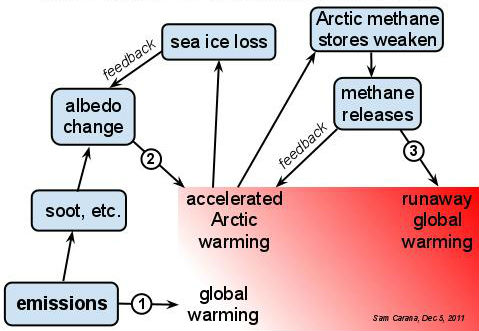
This comes on top of warming that is already accelerated in the Arctic. Albedo changes alone could cause more warming than all emissions by people globally, according to calculations by Prof. Peter Wadhams, who also describes things in the video below.


The resulting temperature rises in the Arctic threaten to trigger further methane releases from the seabed and wildfires on land in the Arctic, further driving up temperatures in an exponential spiral of runaway global warming.

In conclusion, we need a climate plan that will genuinely produce the necessary action, i.e. a comprehensive and effective climate plan as articulated at http://climateplan.blogspot.com

Thursday, November 15, 2012

Arctic methane: Why the sea ice matters


Arctic methane: Why the sea ice matters 
a new film by Envisionation.co.uk
Interviews with:
James Hansen - NASA
Natalia Shakhova - IARC
Peter Wadhams - Cambridge University, UK
David Wasdell - Apollo-Gaia Project


Arctic Methane: Why The Sea Ice Matters

James Hansen: If it begins to allow the Arctic Ocean to warm up and warm the ocean floor, then we'll begin to release methane [from] hydrates, and if we let that happen, that's a potential tipping points that we don't want to pass. There are now observations that methane is beginning to be released by both melting tundra on the land and bubbling up in the Arctic Ocean, indicating some warming of the Arctic Ocean.

Natalia Shakhova: The total amount of methane in the current atmosphere is about 5 Gt. The amount of carbon preserved in the form of methane in the East Siberian Arctic Shelf is ~ from hundreds to thousands Gt. What divides this methane from the atmosphere is a very shallow water column and a weakening permafrost, which is losing its ability to serve as a seal. This area is very seismically and tectonically active and there was some investigation that the tectonic activity is increasing.

Peter Wadhams: At the rate we're going, it will bring us to an ice-free Arctic in about four years time. [The Arctic Ocean] now warms up to about 5 degrees [5oC or 41oF, i.e.] enough to start warming up the seabed. The seabed at the moment is frozen, but it's now starting to melt. That's allowing a lot of methane which is trapped under the permafrost to be released. That's a large boost to global warming, because methane is an extremely powerful climatically-active gas. 

David Wasdell: The warm water from the surface is now being mixed down to those areas that it never reached when the whole area was covered in sea ice. As soon as the area is open water, you have a process of heating that goes right down to those clathrate deposits on the seabed. The more the methane is released into the atmosphere, the faster the heating goes. It's probably the greatest threat we face, as a planet. We're already in a mass extinction event.

Tuesday, October 16, 2012

Albedo change in the Arctic threatens to cause runaway global warming

Mark Flanner et al. calculated in 2011 that snow and ice on the Northern Hemisphere had a combined cooling effect of 3.3 Watts per square meter (of which 2 W/sm relates to the snow cover on land and 1.3 W/sm to the sea ice).

This cooling effect is deminishing rapidly, as temperatures rise and snow and ice cover declines. Snow and ice on the Northern Hemisphere had already declined substantially over the years and was reflecting 0.45 watts less energy per square meter in 2011 than it did in 1979 (Flanner, 2011).

As discussed in Albedo change in the Arctic, Professor Peter Wadhams calculates that the loss of the Arctic sea ice cooling effect alone can be compared to the net global warming caused by people's emissions (1.66 W/sm, IPCC, 2007b).
From: sites.google.com/site/arctischepinguin/home/piomas

The exponential trends added by Wipneus to PIOMAS Arctic sea ice volume data show that the Arctic Ocean looks set to be ice-free from 2015 onwards for the period from August through to October, while July and November look set to follow from 2017, respectively 2018 onwards with June following closely thereafter. In other words, we could soon face an Arctic Ocean that is ice-free for half the year.

Snow cover on land takes up an even larger area than sea ice. The chart below illustrates the decline of snow cover on land in the Northern Hemisphere (without Greenland) for the month June.


What trends could fit these data? On the image below, I've added trendlines and I encourage others to come up with better ones.

Clearly, a lot of snow and ice looks set to disappear over the next few years. Note that what happens in winter doesn't matter as much, as little sunlight reaches the Arctic in winter. What matters most is how much sunlight is reflected when insolation in the Arctic is high. Insolation during the months June and July is higher in the Arctic than anywhere else on Earth, as shown on the image below, by Pidwirny (2006).


While Greenland remains extensively covered with snow and ice, the reflectivity of its cover shows rapid decline, as illustrated by the image below. The July data since 2000, from the meltfactor blog with projection in red added by Sam Carana, suggest a exponential fall in reflectivity that looks set to go into freefall next year.
From: Greenland is melting at incredible rate

Albedo: wikipedia.org/wiki/Albedo

A drop of as little as 1% in Earth’s albedo corresponds with a warming roughly equal to the effect of doubling the amount of carbon dioxide in the atmosphere, which would cause Earth to retain an additional 3.4 watts of energy for every square meter of surface area (NASA, 2005; Flanner et al., 2011).

Combined, the snow line retreat, loss of sea ice and decline of Greenland's reflectivity constitute a huge loss of summer cooling in the Arctic.

As a result, summer temperatures in the Arctic look set to rise rapidly over the next few years, threatening to unleash massive amounts of methane from sediments below shallow waters of the Arctic Ocean, spiraling Earth into runaway global warming.

If you are also concerned about this development, please share the image below at Facebook, with a link to this post.


References
- Albedo - Wikipedia
wikipedia.org/wiki/Albedo

- Albedo change in the Arctic
arctic-news.blogspot.com/2012/07/albedo-change-in-arctic.html

- Flanner et al. (2011), Radiative forcing and albedo feedback from the Northern Hemisphere cryosphere between 1979 and 2008.
nature.com/ngeo/journal/v4/n3/full/ngeo1062.html

- Flanner et al. (2011), Presentation October 27, 2011, WCRP Open Science Conference
wcrp-climate.org/conference2011/orals/B11/Flanner_B11.pdf

- Greenland is melting at incredible rate
arctic-news.blogspot.com/2012/07/greenland-is-melting-at-incredible-rate.html

- NASA, 2005 (at Archive.org)
archive.org/details/albedo_ceres_mar05

- Pidwirny, M. (2006). "Earth-Sun Relationships and Insolation". Fundamentals of Physical Geography, 2nd Edition. 
physicalgeography.net/fundamentals/6i.html

- PIOMAS monthly average sea ice volume, with exponential trends added
sites.google.com/site/arctischepinguin/home/piomas

- Snow Climate Lab, Rutgers University
climate.rutgers.edu/snowcover

Wednesday, October 10, 2012

Saving the Arctic Ice (#1)

By Nathan Currier

Greenpeace, Greenwashing and Geoengineering

Nathan Currier, senior climate advisor for Public Policy Virginia

There was much media attention a couple of weeks ago when this year's sea ice extent minimum broke all records: it was down almost 50 percent from the 1979-2000 average. Little attention, though, accompanied a possibly even more significant figure, released a few days ago: those who run the PIOMAS sea ice volume model at the Polar Research Centershowed the 2012 sea ice volume minimum was down almost 50 percent not from decades ago -- but from 2007! That's right: the volume of arctic sea ice this September minimum was probably about half of what it was, just back in 2007. This figure should deeply trouble any reasonable human being, as it strongly suggests reaching an ice-free arctic sea ice minimum within half a decade, and, since there is little dispute that some summer sea ice will persist to the north and west of Greenland for much longer, the first "near-ice-free" point will likely arrive in just the next few years, as sea ice expert Peter Wadhams has pointed out, and the London-based policy group and think tank Ameg has maintained.

How should we respond? Greenpeace recently started a "Save the Arctic" campaign. That's great -- but you can only save the arctic by saving its ice. And, unfortunately, it is now clear that this can no longer be achieved through emissions reductions alone. It's too late for that. Greenpeace held ameeting on the polar emergency in New York City, by chance on the same day the record extent minimum was called, and while on the surface it seemed pretty ordinary, it was at heart very odd. Nobody suggested any change of approach, any specific re-strategizing, to respond to the accelerating situation. The word emergency was a common currency passing all lips, but in fact it was unclear whether people were really speaking the same language, especially as concerns that most precious thing in emergencies -- time. And there seemed to be no translator in the room, saying "this is the timescale of this, that's the timescale of that."

The meeting's two scientists, Wieslaw Maslowski (on ice) and James Hansen (general climate), themselves focusing on somewhat different time scales, were followed by the 'social/political' panel discussing what we should do: the panel discussed green energy, solar power, how we shouldn't move towards nuclear, that kind of stuff. But Jim Hansen had said in answer to a question (mine), "We are going to lose that sea ice," and also said that to save it, "You could do some quick things." As I'll discuss in my next post, Hansen meant geoengineering. Greenpeace Director Kumi Naidoo later couldn't even remember the word -- geoengineering. But if he's going to save the arctic, I'm afraid he's going to need to know it.

A big issue in whether to consider something an important 'threshold' is its reversibility, and we will discuss the reversibility of this one further in the next episode. At the meeting, since Maslowski focused on sea ice modeling failures, and Hansen on the whole climate picture, many of the potential immediate physical impacts of allowing this coming ice loss remained poorly or not at all elaborated -- although they are important for Greenpeace, and everyone else, to understand, I feel. Hansen showed a slide of three major tipping points which he said place us in a climate 'emergency,' because one can lose control around tipping points. One was methane hydrate, for example. But what Hansen didn't show were what I might dub the 'minor tipping points,' far more immediate changes stemming from this coming loss, which could make it hard to turn around, and could lead us straight to those more major ones Hansen fears, in a slippery slope.

Keep in mind that what we're talking about here is losing almost as much summer ice cover in just the next few years as we have over the last few decades, and that these are all circularly interrelated reinforcing mechanisms. Sorry, if it seems a bit mind-numbing for some readers, but here's my list:

1. Greatly increased arctic water vapor, increasing arctic warming (water vapor is a potent greenhouse gas) but also fundamentally altering arctic hydrology and hence weather patterns.

2. Immediately and fundamentally altered arctic atmospheric chemistry, causing increased arctic methane lifetime, among other basic changes.

3. Certain increase in acceleration of arctic warming, from increased solar energy entering the arctic ocean (this engenders 1.) and the release of latent heat into the atmosphere during autumn's rapid re-freezing.

4. Consequent increased potential for large arctic storms like the Great Arctic Cyclone this summer.

5. Consequent increased deep convection events (mixing to bottom) of arctic ocean, particularly important over the shallow water of the shelves, where lower layers can now often be methane-saturated.

6. Consequently an increase of seabed methane emissions -- including from seabed permafrost, shallow methane hydrate, and from thawing of either or both of these and increased gas migration pathways allowing free gas from underneath the hydrates to outgas.

(For full PowerPoint PDF, scroll down to Topic/Title Methane Release from Eastern Siberian Shelf.)

7. This increase in seabed permafrost thawing leads to a subsequent increased risk that a random seismic event could suddenly release large amounts of methane from the above combination of thawing sources, or from other thawed arctic carbon stores (see PowerPoint above).

8. Increased risk of general degradation of shallow methane hydrates leading to slope failure and consequent methane release.

9. Certain increase in chronic emissions of methane (and CO2) from thawing land permafrost, peat, etc. with the general added warming mentioned above.

10. The increased arctic methane lifetime (2.) is indistinguishable from an increase in its arctic abundance.

11. Increasing continued rate of ice (and snow) loss as the ice-free-period subsequently lengthens, from all the above, particularly significant as the insolation increases earlier in the season to around the solstice in June (discussion here, scroll down to An Ice-free Solstice).

And here are some immediate potential global impacts to chew on:

12. Recent research suggests that ice (and snow cover) loss is at least one causative factor in recentextreme weather -- drought, flood, fires, etc. -- and if so this could quickly be amplified.

13. Consequently, recent global impacts on food security could increase proportionally.

14. Economic losses from each of those (12., 13) would probably increase proportionally, and potentially could amplify into global economic recession or even depression.

15. If there's large-scale (multi gigaton-scale) methane release soon, this would of course fundamentally alter the whole path of global warming (see my Twilight posts #1,#2), with vast consequences.

16. If the ice-free period expands significantly, altered arctic tropospheric oxidation could rapidly start to impact high latitude urban areas, making cities with large populations rapidly become more difficult to live in (good discussion here at GISS, where Hansen is himself director).

No one said a word at the Greenpeace meeting, seemingly dismissing it as a major threshold at all. No one ever said, "Let's fight this." But I am suggesting that you should see skull and crossbones hanging above this threshold crossing. Like playing around high voltage wires or train tracks, allowing this threshold to be crossed will add considerable risk. And I'm suggesting that it will be crossed in just the next few years, unless we do something about it.

As I'll discuss next time, it might prove much harder to reverse than many assume within the climate world. Therefore, as Energy Secretary Steven Chu said about allowing an eventual runaway arctic permafrost carbon feedback, we must all say loudly now about this initial step onto that vast and treacherous slippery slope: "We cannot go there!" And if we don't want to go there, there's now no longer any question -- geoengineering will have to be part of the remedy.

[First posted at the Huffington Post; posted with author's permission]

Saturday, September 22, 2012

Professor Peter Wadhams calls for action

In the Youtube video below, Professor Peter Wadhams, Professor of Ocean Physics and Head of the Polar Ocean Physics Group of the University of Cambridge and one of the world's top sea-ice experts, joins The Big Picture, a show with Thom Hartmann filmed live and broadcast from the RT America studios in Washington DC.

Professor Wadhams warns that the Arctic sea ice looks set to be completely melted in just a few years. Professor Wadhams adds that action is needed that includes not only emissions cuts, but also geoengineering methods.

It was a Skype connection, so the sound quality was not optimal, but Peter Carter has improved this in the version below. Anyway, the message is important enough to be watched closely and to be further shared and discussed.


The diagram below illustrates this further.

more on this diagram

As the Arctic sea ice retreats, an ever smaller area remains in summer. Snow cover on the ice reflects between 80% and 90% of sunlight, while the dark ocean without ice cover reflects only 7% of the light, explains Stephen Hudson of the Norwegian Polar Institute. As the sea ice cover decreases, less solar radiation is reflected away from the surface of the Earth in a feedback effect that causes more heat to be absorbed and consequently melting to occur faster still.

The image below shows the retreat in September 2012 to date, compared with 7 other recent years.

credit: Arctic Sea Ice Blog
The image below further illustrates the rate at which Arctic sea ice is declining, and thus losing  its reflectivity.

Image produced by Peter Carter based on NSIDC images, showing the now exposed permafrost areas that extend from the continents into the shallow parts of the Arctic Ocean. 

NASA images showing the difference between sea ice cover between 1980 and 2012.

If you like, read more about this at the post Albedo change in the Arctic.

Wednesday, September 12, 2012

An accounting is now due

By Nathan Currier

Arctic Crisis: Far From Sight,
the Top of the World's Problems

Nathan Currier, senior climate advisor for Public Policy Virginia

As this year's sea ice extent bottoms out, it's high time that more people recognize we're in a global crisis -- the Arctic crisis. I'm sorry if this sounds “alarmist”, but the Arctic, fundamental to the stability of our weather patterns, climate and agriculture, is rapidly coming apart. In the end, of course, this will just be a sub-plot to the bigger drama, the climate crisis, but by naming this the arctic crisis, I am suggesting that it needs to be treated independently, right away. It is the heart of the near-term climate issue, and its outcome could greatly alter the outcome of the larger story, which will be the saga of the century no matter what we do.

A crisis above all means this: a compression of time. In a medical crisis, for example, we expect that there will initially be the need to regain stability through some immediate means, and then other courses of treatment will be added subsequently to address the underlying problems. If the initial steps are not taken quickly enough, the whole trajectory can be different, rendering something quite manageable more dire, potentially even fatal. Because the arctic, which has received the brunt of warming, seems poised to pass a profound state shift in the very near future (in fact it's already underway), and because it offers such vital 'services' to the planet, one could say that the urgency of the larger climate crisis is for the time being mostly contained within this arctic crisis.

But before looking at what to do, or even describing what's at stake, there's another order of business to turn to. An accounting is now due. Today I want to look back at the most authoritative recent opinions suggesting that this isn't a crisis, and see how they've been holding up. In our pre-election season of fact-checking, let's call this the 'Arctic crisis debate' fact-checking 101. But since no one else has really been referring to an Arctic crisis, what we'll be looking at are some prominent statements from 2012 concerning the two great interrelated features of arctic stability: the state of its cryosphere, and the state of its carbon stocks. In particular, the sea ice and methane.

An accounting
is now due! 

When I last wrote, it was after a flurry of methane articles, including the front page New York Times article last December on the danger of increasing arctic methane emissions, followed by David Archer's curious Much Ado about Methane piece in RealClimate, the leading climate science blog. That article put strangeness into high gear by essentially discounting the value of near-term climate altogether. But Much Ado about Methane was valuable, too, in that Archer unwittingly demonstrated, with all his authority, just how far from 'Nothing' reasonably likely arctic methane releases could be. Archer provided a graph in his follow-up showing the radiative impact of a 10Gt release, only about 20% of what leading researchers of the Eastern Siberian Shelf (ESAS) think could potentially come from that region alone in the relatively near future. [Very little methane hydrate need be involved, incidentally: imagine some seismic event there, where a little shallow hydrate, a mere .05% of the hydrate there, gets released, destabilizing just .5% of the permafrost cap along with it, which gets metabolized to methane, and all this creates increased gas migration pathways for just 1% of the free gas from below -- that's 10Gt.] Radiative forcing, the measure scientists use to describe global warming, would jump globally to about 300% of its current level of increase since industrialization, and this would begin to express itself in the climate system almost right away. Much ado, indeed: that methane wouldn't be nothing.

In my last piece, I said I would quickly follow up with another one discussing what should be done to avoid such dangers, but have since remained silent. That's for a variety of reasons, one of them being a growing involvement with a group based in the UK called the Arctic Methane Emergency Group (AMEG), focused on just this question. And almost as soon as this began, RealClimate published a piece on arctic sea ice predictions, in which AMEG -- which has projected that summer sea ice could approach an ice-free minimum just a few years from now -- seemed a primary target.

Called Arctic Sea Ice Volume: PIOMAS, Prediction and the Perils of Extrapolation, it was written by a guest, Axel Schweiger (with Ron Lindsay and Cecilia Bitz), part of the team that runs the PIOMAS sea ice model at the Polar Science Center. The 'perils' it discussed were those of AMEG's use (or misuse) of their PIOMAS model, and some of us were actually flattered that our ragtag army of citizen scientists, along with a few major climate figures willing to brave academic censure for taking positions outside the status quo, like renowned sea ice expert Peter Wadhams, were receiving cannonballs lobbed from the heart of the climate establishment.

Now, it's almost a half year later, the sea ice minimum is upon us, and the ice has been doing just what AMEG predicted. As Neven Acropolis, who runs the Sea Ice Blog, wrote last week, he's particularly at a loss for words because the 2007 record has been shattered without this summer's arctic temperatures being particularly conducive to such large ice loss, which perhaps suggests something about the extraordinary underlying nature of what is taking place.

Meanwhile, AMEG had already presented its case, both in writing and orally, before a panel of the UK Parliament, on both sea ice and methane release, back at the beginning of the year. AMEG's testimony was rebutted by Julia Slingo, Chief Scientist for the UK Met Office. Now, how has this Met Office testimony held up since?

Unlike RealClimate, the Met Office chief scientist dismissed PIOMAS modeling altogether, saying that she expected better data, fitting their Hadley Center climate models, to come in soon. That data hasn't come. Far from it. Instead, just last month, the media was filled with news pieces about how the European Space Agency's new CryoSat-2, a satellite designed to read ice volume, showed far greater volume losses than expected -- much in line with PIOMAS modeling, and supportive of AMEG's position. Near the opening of her testimony, Prof. Slingo said that the 2007 melting event was really an “advecting” of ice, coming from extreme weather over the arctic, and not really a melting event per se. Of course, we have just noted how that 2007 record has now been widely surpassed, without such weather (nor with losses coming primarily from advection).

And when it came to methane, and the danger of releases from the arctic seabed, the UK Met Office's chief scientist said: “I think there is a lack of clarity in thinking about how that heating at the upper level of the ocean can get down, and how rapidly it can get down into the layers of the ocean.”

The Great Arctic Cyclone of 2012 has perhaps provided her with a little more clarity. Beyond that, the Chief Scientist's statement was embarrassing: after all, even those most convinced that there is little danger of large immediate methane releases do not doubt the well established and drastic warming of the sea bottom precisely in the most methane-rich areas (see this paper), and Lena river discharge also greatly impacts the seabed in some of this same region, providing yet another mechanism for seabed warming. Prof. Slingo said: “At the moment, our estimates are that the increases in sea floor temperatures that have been observed have at the most been about one-tenth of a degree, except in one or two regions, like the West Spitsbergen Current.”

Clearly, Prof. Slingo doesn't seem to have studied the ESAS, where anomolies of 5ºC at the seabed have been recorded, where almost all of it has warmed some 20 times more than she says (and is still currently warming, ten times more than she suggests per decade), where significant areas of permafrost cap are thawing or already thawed, and where methane is starting to be released (see my own last post on all these points). Unlike the phony “Climategate” scandal, this is a true embarrassment for climate science. And if such “expert” testimony helps the arctic climate to pass through some invisible gate without our society lifting a finger to stop it, it will also turn out to have been one of the greatest tragedies of modern times.

So, how now, for the ice and methane? Schweiger's Perils of Extrapolation piece clearly stated how PIOMAS shows September sea ice volumes having dropped by a breathtaking 75% over just the last few decades (1979-2011). It might even seem simple to deduce that ice-free minima would be arriving quite soon, given this. But it is, I would agree, a vastly complex situation. Fully coupled models - those that do not, like PIOMAS, leave out the atmosphere, the weather, etc., but that try to create a realistic world that can be run into the future -- almost all suggest an eventual dampening effect on the underlying feedbacks leading to ice loss once it is mostly gone, thus leading to a long 'tail' of one or more decades in which a small amount of thinner summer ice remains, rather than an imminent disappearance, as both AMEG's Peter Wadhams and Wieslaw Maslowski, whose work Gore cited in his 2007 Nobel speech, have suggested.

That dampening, however, isn't happening. One almost feels sorry for Gavin Schmidt at RealClimate these days. After their latest sea ice update, he repeated in its comment thread how there is no reason to extrapolate PIOMAS into the future using an exponential curve (which shows a collapse just a few years from now). RealClimate wants to deal with the real underlying physical mechanisms involved, not just take some simple line that best fits the ice's past behavior and then extrapolate that line into the future. But, darn! The newest PIOMAS data have just been released last week, and, again, that exponential curve is being eerily followed by the real world's sea ice! In fact, Wieslaw Maslowski has also developed a new model recently, a fully coupled model free from 'perilous extrapolations,' which shows much the same thing as his prior research -- that a summer sea ice collapse is likely in the coming years, not decades.

As you can see, the reasons for thinking that there isn't an arctic crisis are about as firm as cotton candy. Next you'll need to learn the more solid reasons for suspecting that there is one. Then, after that, the big questions -- What real climate perils could this entail? What should we be doing about it right now? -- are what one needs to turn to next.

[First posted at the Huffington Post; posted with author's permission]

Wednesday, September 5, 2012

Arctic sea ice loss is effectively doubling mankind's contribution to global warming

Loss of Arctic sea ice is effectively doubling mankind's contribution to global warming. Increased absorption of the sun's rays is "the equivalent of about 20 years of additional CO2 being added by man", Professor Peter Wadhams said in the BBC article: Arctic ice melt 'like adding 20 years of CO2 emissions', by Susan Watts, September 5, 2012.

For more details on Professor Wadhams' calculations, see the earlier post Albedo change in the Arctic.

Arctic sea ice area fell by 11.33629 million square km from March 28, 2012, to September 1, 2012, as shown on the image below, edited from The Cryosphere Today. That's an 82.7 percent fall in 157 days. 


The image below shows Arctic sea ice extent (total area of at least 15% ice concentration) for the last 7 years, compared to the average 1972-2011, as calculated by the Polar View team at the University of Bremen, Germany.

There still are quite a few days to go in the melting season, so the fall could be even more dramatic.

Peter Wadhams adds:  “The point about summer conditions is that as long as there is SOME ice present on the sea surface, however thin the layer, then the ocean temperature below it is held to 0 degrees Celsius because the absorbed solar radiation melts the ice rather than warming the water. Also the atmospheric temperature is held to close to 0 degrees Celsius because warmer air melts the surface snow layer on top of the ice and is thereby cooled. The sea ice, even when thinned, continues to act with 100% efficiency as an air conditioning system for ocean and atmosphere alike.”

“BUT”, Prof Wadhams continues, “as soon as the sea ice layer goes, this process ceases and the sea can warm up rapidly (to typically 7 degrees Celsius by the end of summer - which is not much colder than the North Sea), as can the atmosphere (which speeds up Greenland ice sheet melt when that warmed air passes over Greenland). Latent heat is an enormously powerful buffer - the amount of heat that you have to pump in to melt 1 kg of ice will subsequently heat that same amount of melted water to 80 degrees Celsius. So once the ice goes away entirely there is a big jump in temperatures in the upper ocean and atmosphere (with dire consequences for permafrost), and it is very difficult to see how one can ever go back to an ice-covered summer ocean once this has happened.”

In the August 27, 2012, BBC article Arctic sea ice reaches record low, Nasa says, by Roger Harrabin, Professor Peter Wadhams said: “Implications are serious: the increased open water lowers the average albedo [reflectivity] of the planet, accelerating global warming; and we are also finding the open water causing seabed permafrost to melt, releasing large amounts of methane, a powerful greenhouse gas, to the atmosphere.”

Indeed, there is a danger that loss of the sea ice will weaken the currents that currently cool the bottom of the sea, where huge amounts of methane may be present in the form of free gas or hydrates in sediments. This danger is illustrated by the image below by Reg Morrison.


The image below, from a study by Polyakov et al., shows temperature differences in the vertical water column at selected stretches of water in the Arctic over the years.

[click images to enlarge]