A United Nations panel has deleted a reference to gays and lesbians in a resolution condemning unjustified executions.
The motion was introduced by Morocco and Mali and the vast majority of countries in support were African or Arabic.
Many of the supporting countries criminalise homosexuality and five treat it as a capital offence.
The amendment called for the words “sexual orientation” to be replaced with “discriminatory reasons on any basis”. The resolution makes explicit reference to a large number of groups, including human rights defenders, religious and ethnic minorities and street children.
It narrowly passed 79-70 and was then approved by the UN General Assembly committee with 165 in favour and ten abstentions.
The amendment, which condemns extrajudicial, summary and arbitrary executions and other killings, is voted on by the UN General Assembly every two years.
It has contained a reference to sexual orientation for the last ten years.
Cary Alan Johnson, executive director of the International Gay and Lesbian Human Rights Commission, said: “This vote is a dangerous and disturbing development.
“It essentially removes the important recognition of the particular vulnerability faced by lesbian, gay, bisexual and transgender people – a recognition that is crucial at a time when
76 countries around the world criminalise homosexuality, five consider it a capital crime, and countries like
Uganda are considering adding the death penalty to their laws criminalising homosexuality.”
‘Shameful’ UN vote ‘may lead to more gay executions’A United Nations panel’s decision to remove sexual orientation from an anti-execution resolution is “shameful” and may encourage murders of LGBT people, gay rights campaigners say.
The body voted this week on the amendment, which was passed 79-70. The vast majority of countries in support of the change were African or Arabic.
Veteran gay rights activist Peter Tatchell said the move was a “shameful day in United Nations history” and would give a “de facto green light to the on-going murder of LGBT people by homophobic regimes, death squads and vigilantes”.
Gay rights group Stonewall also criticised the move and said the government should “lead from the front foot” to end homophobic persecution.
Chief executive Ben Summerskill said: “The vote by a UN panel to remove sexual orientation from this significant resolution is deeply disturbing. Lesbian, gay and bisexual people face violence, abuse and in some states, execution, because of their sexual orientation.
“This is a worrying and regressive step. We call on the UK government to lead from the front foot to end the persecution of gay people in other countries.’
The resolution, which the UN votes on every two years, has contained a reference to lesbian and gay people since 1999. It condemns extrajudicial, summary and arbitrary executions and other killings.
It still includes references to a variety of other groups, such as human rights defenders, religious and ethnic minorities and street children.
Introduced by Morocco and Mali, the amendment called for the words “sexual orientation” to be replaced with “discriminatory reasons on any basis”.
Mr Tatchell said homophobic countries would “take comfort from the fact that the UN does not endorse the protection of LGBT people against hate-motivated murder”.
He added: “The UN vote is in direct defiance of the Universal Declaration of Human Rights, which guarantees equal treatment, non-discrimination and the right to life. What is the point of the UN if it refuses to uphold its own humanitarian values and declarations?
“Many of the nations that voted for this amendment want to ensure that their anti-gay policies are not scrutinised or condemned by the UN. Even if they don’t directly sanction the killing of LGBT people, they have lined up alongside nations that do.”
Mr Tatchell also criticised South Africa and Cuba, who voted in favour of the amendment.
“Presidents Raul Castro and Jacob Zuma should hang their heads in shame. They’ve betrayed the liberation ideals that they profess to uphold,” he said.
Earlier this week, Cary Alan Johnson, executive director of the International Gay and Lesbian Human Rights Commission, said the vote was a “dangerous and disturbing development” for gay people.
Source:
Pink News, November 19, 2010
UN panel cuts gay reference from violence measure
November 16, 2010: Arab and African nations succeeded in getting a U.N. General Assembly panel to delete from a resolution condemning unjustified executions a specific reference to killings due to sexual orientation.
Western delegations expressed disappointment in the human rights committee's vote to remove the reference to slayings due to sexual orientation from the resolution on extrajudicial, summary and arbitrary executions.
The General Assembly passes a resolution condemning extrajudicial, summary and arbitrary executions and other killings every two years. The 2008 declaration included an explicit reference to killings committed because of the victims' sexual preferences.
But this year, Morocco and Mali introduced an amendment on behalf of African and Islamic nations that called for deleting the words "sexual orientation" and replacing them with "discriminatory reasons on any basis."
That amendment narrowly passed 79-70. The resolution then was approved by the committee, which includes all 192 U.N. member states, with 165 in favour, 10 abstentions and no votes against.
The resolution, which is expected to be formally adopted by the General Assembly in December, specifies many other types of violence, including killings for racial, national, ethnic, religious or linguistic reasons and killings of refugees, indigenous people and other groups.
"It's a step backwards and it's extremely disappointing that some countries felt the need to remove the reference to sexual orientation, when sexual orientation is the very reason why so many people around the world have been subjected to violence," said Philippe Bolopion of Human Rights Watch.
Source: Reuters, November 16, 2010
Countries that voted to delete sexual orientation from anti-execution measures:
Afghanistan, Algeria, Angola, Azerbaijan, Bahamas, Bahrain, Bangladesh, Belize, Benin, Botswana, Brunei Dar-Salam, Burkina Faso, Burundi, Cameroon, China, Comoros, Congo, Cote d’Ivoire, Cuba, Democratic People’s Republic of Korea, Democratic Republic of Congo, Djibouti, Egypt, Eritrea, Ethiopia, Ghana, Guyana, Haiti, Indonesia, Iran, Iraq, Jamaica, Jordan, Kazakhstan, Kenya, Kuwait, Lebanon, Lesotho, Liberia, Libya, Madagascar, Malawi, Malaysia, Maldives, Mali, Morocco, Mozambique, Myanmar, Namibia, Niger, Nigeria, Russian Federation, Rwanda, Saint Kitts and Nevis, Saint Lucia, Saint Vincent and Grenadines, Saudi Arabia, Senegal, Sierra Leone, Somalia, South Africa, Sudan, Suriname, Swaziland, Syrian Arab Republic, Tajikistan, Tunisia, Uganda, United Arab Emirates, United Republic of Tanzania, Uzbekistan, Vietnam, Yemen, Zambia, Zimbabwe.
Countries that voted against:
Andorra, Argentina, Armenia, Australia, Austria, Belgium, Bhutan, Bosnia-Herzegovina, Brazil, Bulgaria, Canada, Chile, Costa Rica, Cyprus, Czech Republic, Denmark, Dominican Republic, Ecuador, El Salvador, Estonia,Finland, France, Georgia, Germany, Greece, Guatemala, Hungary, Iceland,India, Ireland, Israel, Italy, Japan, Latvia, Liechtenstein, Lithuania, Luxembourg, Malta, Mexico, Micronesia, Monaco, Montenegro, Nepal, Netherlands, New Zealand, Norway, Panama, Paraguay, Peru, Poland, Portugal, Republic of Korea, Republic of Moldova, Romania, Samoa, San Marino, Serbia, Slovakia, Slovenia, Spain, Sweden, Switzerland, Former Yugoslav Republic of Macedonia, Timor-Leste, Ukraine, United Kingdom, United States, Uruguay, Venezuela.
Countries that abstained:
Antigua-Barbuda, Barbados, Belarus, Cambodia, Cape Verde, Colombia, Fiji, Mauritius, Mongolia, Papau New Guinea, Philippines, Singapore, Sri Lanka, Thailand, Trinidad and Tobago, Tuvalu, Vanuatu.
The International Lesbian, Gay, Bisexual, Trans, and Intersex Association (ILGA) said in a May 2010 report that 76 nations criminalize "consensual sexual acts between persons of the same sex in private over the age of consent." To see the full report and maps as well as details on gay equality around the world, visit tinyurl.com/ilga-ssh. |
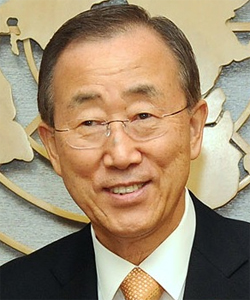
UN secretary-general
Ban Ki-moon |
UN secretary-general Ban Ki-moon’s remarks at a panel on Human Rights Day.
Thank you, Ambassador Jim McLay of New Zealand, Ambassador Ranko Viloviæ of Croatia, Excellencies, Ladies and Gentlemen, and particularly representatives of civil society, it is a great pleasure.
Thank you all for coming to this important event.
Today is Human Rights Day – a day we dedicate to defending freedoms and protections for all people.
We know how controversial the issues surrounding sexual orientation can be.
In the search for solutions, we recognise that there can be very different perspectives.
And yet, on one point we all agree – the sanctity of human rights.
As men and women of conscience, we reject discrimination in general, and in particular discrimination based on sexual orientation and gender identity.
When individuals are attacked, abused or imprisoned because of their sexual orientation, we must speak out.
We cannot stand by. We cannot be silent.
This is all the more true in cases of violence.
These are not merely assaults on individuals.
They are attacks on all of us.
They devastate families. They pit one group against another, dividing larger society.
And when the perpetrators of violence escape without penalty, they make a mockery of the universal values we hold dear.
We have a collective responsibility to stand against discrimination, to defend our fellow human beings and our fundamental principles.
Ladies and gentlemen,
Liberal democracy has spread in many parts of the world in recent decades.
In general, more and more of us have learned to cherish our diversity.
Today, many nations have modern constitutions that guarantee essential rights and liberties.
And yet, homosexuality is considered a crime in more than 70 countries.
This is not right.
Yes, we recognise that social attitudes run deep.
Yes, social change often comes only with time.
Yet, let there be no confusion:
Where there is tension between cultural attitudes and universal human rights, universal human rights must carry the day.
Personal disapproval, even society’s disapproval, is no excuse to arrest, detain, imprison, harass or torture anyone – ever.
Excellencies, ladies and gentlemen,
From my first days in office as secretary-general, I have spoken out against stigma and discrimination.
I have worked, with some success, to persuade governments to lift travel restrictions on people with HIV.
During my recent trips to Africa, I urged leaders to do away with laws criminalising homosexuality.
I was particularly happy and pleased that, when I was visiting Malawi, I was able to secure the release of a young gay couple sentenced to 14 years in prison. President Mutharika kept his promise and he released them during my stay, on the very day when I urged him to do so.
Yesterday evening, I spoke to a Human Rights Day event at the Ford Foundation. It was called “Speak Up,” a conversation with human rights defenders. Some of you are wearing badges.
One of my fellow speakers was a young activist from Uganda.
Frank Mugisha has been working with a variety of civil society groups to stop legislation that institutionalises discrimination against gay and lesbian people.
With extraordinary eloquence, he appealed to us, the United Nations, for help.
He asked us to rally support for the decriminalisation of homosexuality everywhere in the world.
And that is what we will do.
We have been called upon, and we will answer.
Ladies and gentlemen,
In all these kinds of cases, I put myself on the line.
I take pains to find the right balance between public and private diplomacy to reach difficult solutions.
I will continue to do so.
I will continue to speak out, at every opportunity, wherever I go.
And I will do so because this is the right thing to do.
Because this cause is just.
That is why this day, this very special day, means so much to me.
Human Rights Day commemorates the Universal Declaration of Human Rights.
It is not called the partial declaration of human rights.
It is not the sometimes declaration of human rights.
It is the universal declaration, guaranteeing all human beings their basic human rights ? without exception.
Violence will end only when we confront prejudice.
Stigma and discrimination will end only when we agree to speak out.
That requires all of us to do our part.
To speak out – at home, at work, in our schools and communities.
To stand in solidarity.
Your discussions today are part of that larger campaign, yours and mine.
Together, we seek the repeal of laws that criminalise homosexuality, that permit discrimination on the basis of sexual orientation or gender identity, that encourage violence.
People were not put on this planet to live in fear of their fellow human beings.
The watchwords of civilization have always been tolerance, understanding and mutual respect.
That is why we are here today.
And that is why we ask the nations and the peoples of the world to join us.
To join us in common cause in the name of justice and a better life for all.
Thank you very much.
Source:
Pink News, December 14, 2010
Gay rights row breaks out over amended UN resolutionUS 'incensed' after reference to sexual orientation dropped from protected minorities listA culture war has broken out at the UN over whether gay people should be offered the same protections as other minorities whose lives are threatened.
The issue will come to a head today when the general assembly votes on renewing its routine condemnation of the unjustified killing of various categories of vulnerable people.
It specifies killings for racial, national, ethnic, religious or linguistic reasons, and includes refugees, indigenous people and other groups.
But because of a change promoted by Arab and African nations and approved at committee level, the resolution drops "sexual orientation" and replaces it with "discriminatory reasons on any basis".
The US government says it is incensed at the change, as are gay rights campaigners. "Even if those countries do not support gay rights, you would think they would support our right not to be killed," said Jessica Stern of the New York-based International Gay and Lesbian Human Rights Commission.
Stern said gay people all over the world were frequent targets of violence because of their sexual orientation.
Authorities in Jamaica are investigating a possible hate crime after the killing of a man who belonged to the country's sole gay rights group, earlier this month.
Uganda, among
76 countries that criminalise homosexuality, is debating whether to join the five other countries that consider it a capital crime.
The biennial resolution does not refer to sexual orientation for the first time since 1999. The US ambassador, Susan Rice, said she was "incensed" that the reference was removed, and that the US will attempt to restore it.
The battle underscores the historic split over gay rights among UN members and their diverse religious and cultural sensibilities.
Activists say gay and lesbian issues got only minimal attention at the UN a decade ago.
"There has been slow but steady progress on lesbian, gay, bisexual and transgender rights at the UN," Stern said.
Stern cited as progress UN secretary general Ban Ki-moon's "landmark" speech during a gay rights forum at UN headquarters on Human Rights Day, 10 December, calling for an end to laws around the world that make it a crime to be homosexual.
But as gay rights gain more acceptance in the UN system, some member states are pushing back, said Mark Bromley, of the Washington-based Council for Global Equality, which aims to advance gay rights in American foreign policy. "I think some states are uncomfortable and they are organising to limit engagement on the issue."
"We are seeing a backlash," agreed Stern. "This is an illustration of the tensions around culture at the United Nations, and how power plays out and alliances are made."
On behalf of African countries, Benin introduced the amendment that deleted the sexual orientation reference. The largely Christian country of eight million with a sizeable Muslim population argued that "sexual orientation had no legal foundation in any international human rights instruments".
Morocco, an Arab country that is almost exclusively Muslim, asserted that such selectivity "accommodated particular interests and groups over others" and urged all UN member states "to devote special attention to the protection of the family as the natural and fundamental unit of society".
Western nations opposed the move to delete the mention of sexual orientation. Britain called it "an affront to human dignity", while France and Norway said the move was "regrettable".
The amendment was passed at a committee meeting last month by 79-70, with 17 abstentions.
General assembly resolutions are not legally binding, but rather reflect the views of the majority of the world's nations.
Mark Kornblau, spokesman for the US mission to the UN, said the US will introduce an amendment next week to restore the previous language, including the phrase "sexual orientation" because "this is an issue that is important to us".
Gay groups and human rights activists also have been lobbying missions to the UN in New York in recent days, urging in particular, the delegations that abstained on the amendment to help restore the mention of sexual orientation.
"We only need a few more countries and we can change this vote around," said Boris Dittrich of Human Rights Watch.
But gaining the world's support for gay rights will take far longer.
More than two-thirds of UN members, many of them Muslim nations, are refusing to sign a separate UN statement condemning human rights violations based on sexual orientation and gender identity, especially with regard to the application of the death penalty and extrajudicial, summary or arbitrary executions.
Under the Bush administration in 2008, the US refused to join all other western nations in signing the declaration, arguing that the broad framing of the language in the statement might conflict with US laws.
After Barack Obama took office last year, the US joined other member states to support the declaration, saying it found that the language did not conflict with American laws. Sixty-eight of the UN's member countries have now signed the declaration, and 124 countries have abstained.
Source:
The Guardian, December 21, 2010