
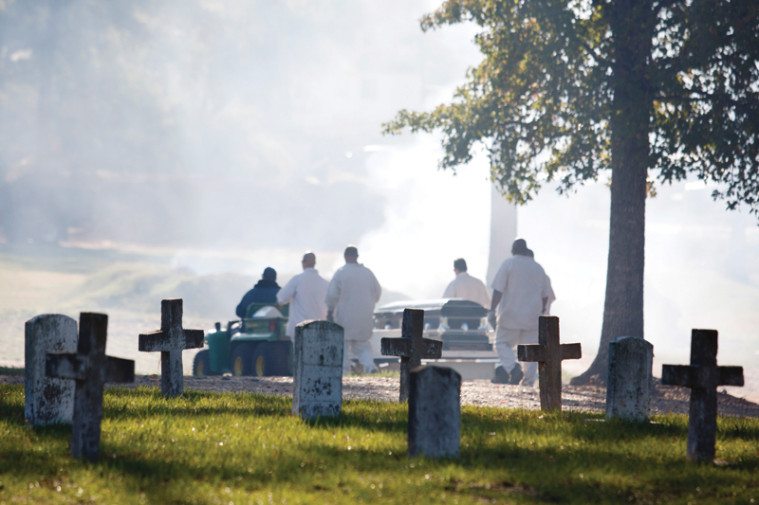
Of the roughly 450 inmates who die in Texas prisons each year, about 100 are laid to rest in Captain Joe Byrd Cemetery. Whether they die in one of the state’s 109 prison units, at the TDCJ hospital in Galveston, or at the prison system’s hospice facility near Palestine, the inmate’s family has the option to claim the body and make funeral arrangements of their choice. When family members can’t be located, or when they decline to claim the body, the state picks up the tab for the funeral and buries the body in TDCJ’s Byrd Cemetery.
The most common reason families don’t claim the body is that they can’t afford to, Chaplain Collier says. Some, like the family that attended today’s visitation at Grace Baptist Church, will decline to claim the body but then attend services in Huntsville. Prison funerals are generally held on Thursdays, unless the deceased has been executed, in which case the burial is often performed the following day; the accelerated schedule saves families who come to witness the execution from having to make a second trip to Huntsville. A typical Thursday may have one or two funerals. Collier says he’s done as many as nine in one day.
He estimates that 60 percent of the services he performs are directs. Sometimes next of kin can’t be located. Other families can’t afford to travel to Huntsville. “You’ve got some that may be in Amarillo, and to come down here is too much,” Collier says. “And I buried one last week that was 80-something years of age, and he probably outlived most of his family.”
If no family or friends attend, the inmates of the cemetery grounds crew stand witness in their stead. These “offenders,” as TDCJ calls them, typically don’t know the deceased, unless the person died at the Walls Unit.
Source: Texas Observer, March 11, 2014

No comments:
Post a Comment